Civilization, If We Can Keep It
And: Epstein's Inner Ring; Serious Conspiracies; Britain Losing Will To Live

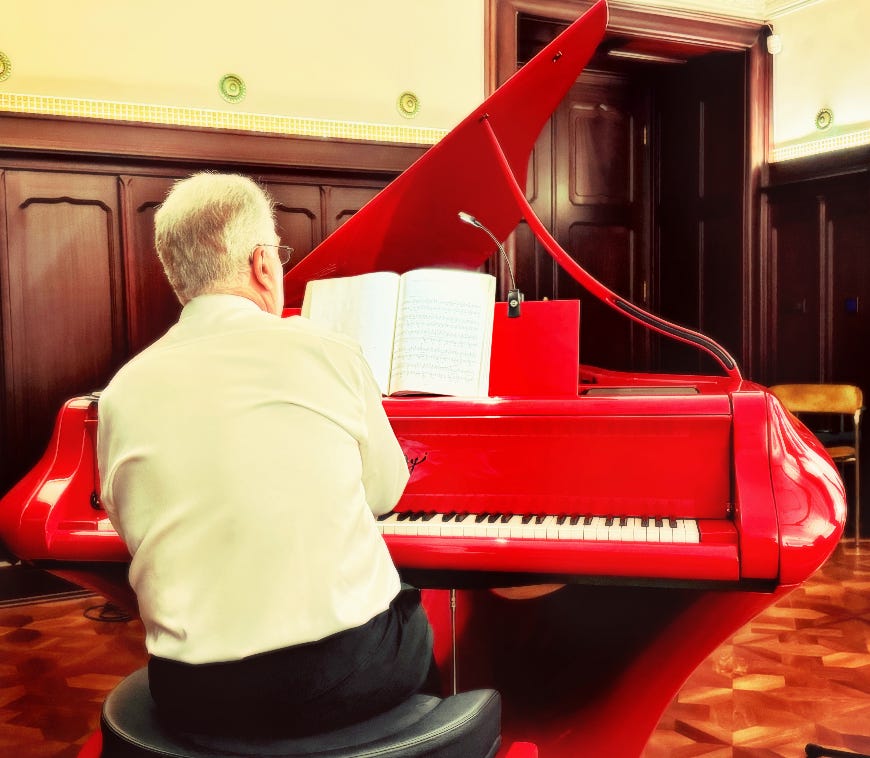
Last night I sat just behind Michael Walsh as he played a recital of the works of Franz Liszt (1811-1886), with a brief appearance on the program by Richard Wagner. He is known here in Budapest as Liszt Ferenc — he was Hungarian by nationality.
Walsh is an accomplished author, journalist (many years with Time magazine), and a gifted musician. I’d met Michael before, on one of his forays to Budapest with his wife Kate, and knew of his considerable reputation as a writer. But I didn’t know a thing about his musicianship until last night. How fortunate I was to be sitting where I was, able to see the difficulty of the musical score in front of him, and to watch his hands move! It was as astonishing thing to experience, a true gift.
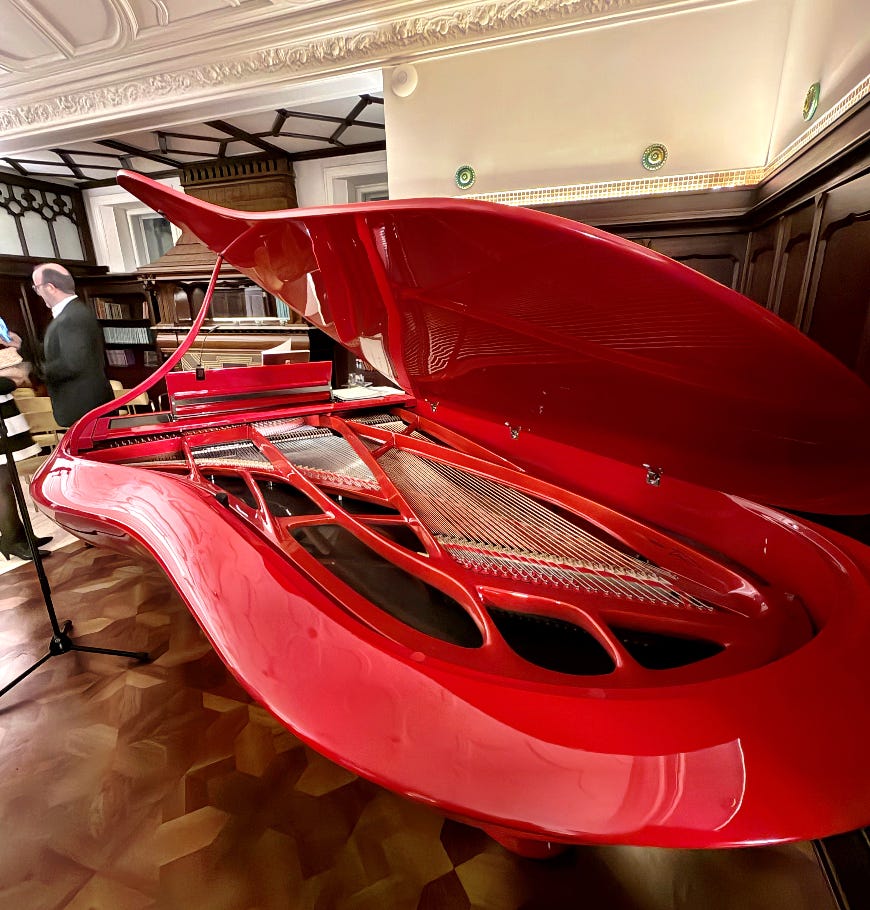
He played on the strangest piano I’ve ever seen. It was designed and made by Gergely Bogányi, a famous contemporary Hungarian concert pianist. Bogányi pianos, I learned last night, are highly prized. Bogányi, Michael told the audience, is a fan of Ferraris. As if one couldn’t tell!

The most astonishing thing he played was the final composition of Liszt’s, the Fourth Mephisto Waltz, which was left unfinished owing to the composer’s death. Michael completed it. I found this version online that shows you the complex handwork this demanding piece requires.
Michael interspersed his performances of each piece with short commentary on the life of Liszt and what inspired the piece he was about to play. What a life Liszt had! He was the classical equivalent of a rock star, causing such madness of crowds when he played that the poet Heinrich Heine coined the term “Lisztomania” to describe it.

He was quite handsome and charismatic, and led a scandalous life with the ladies. And yet he was also quite religious, taking four minor clerical orders (including that of exorcist!) late in his life, after which he was known to some as “Abbé Liszt”. It’s a cliché to say so, but his life really was one of triumph and tragedy. In particular, he lost a number of his children to illness.
This is Liszt’s Sursum Corda, from the part of the mass that begins with the words “Lift up your hearts,” in which the congregation is invited to open itself to the joy of Christ’s presence. It was the last number Michael played. He said, “Try to see if you can detect joy in this piece.”
I listened intently, telling Michael afterwards, “That was the sound of a man pushing through his torment, trying to reach the joy he knows is really there.”
“That,” said Michael, “sums up the life of Liszt.”
What an evening! Michael mentioned to the audience that as a journalist and music critic for Time, he was one of the few who accompanied the pianist Vladimir Horowitz on his triumphal return to the Soviet Union. As a music critic, Michael judged Horowitz the greatest pianist since the great Liszt himself. Here is how Michael’s account for Time began (you can see that he is as good at the typewriter as he is at the keyboard):
Sporting a smart bow tie and clad in his best dark blue suit, the slender young man with carefully combed hair was nervous as he approached the border checkpoint. Officially, his exit visa was for six months’ study in Germany, but he knew that he would not return. His leather suitcase was packed with six shirts, half a dozen butterfly ties, several pairs of socks and a formal cutaway suit. Hidden in his impeccably polished shoes, however, were hundreds of American dollars. In post-revolutionary Russia, he feared being imprisoned or shot for currency smuggling. But it was too late to worry about that. Confidence is the first rule, he thought to himself, reaching for his passport. Like Oscar Wilde, he would have nothing to declare but his genius.
Fortunately, the armed guards were music lovers. At once, they recognized the sensational 21-year-old pianist from Kiev who had had audiences from Moscow to Leningrad on their feet, cheering his pyrotechnical feats of pianistic derring-do. They gave only a perfunctory glance to his papers; instead, they crowded around him, rifles held casually, and pounded him on the back. “Now you go play for the rich over there and fill your pockets with money,” one of them said. “But come back and play for us when your pockets are full. Do not forget the motherland.”
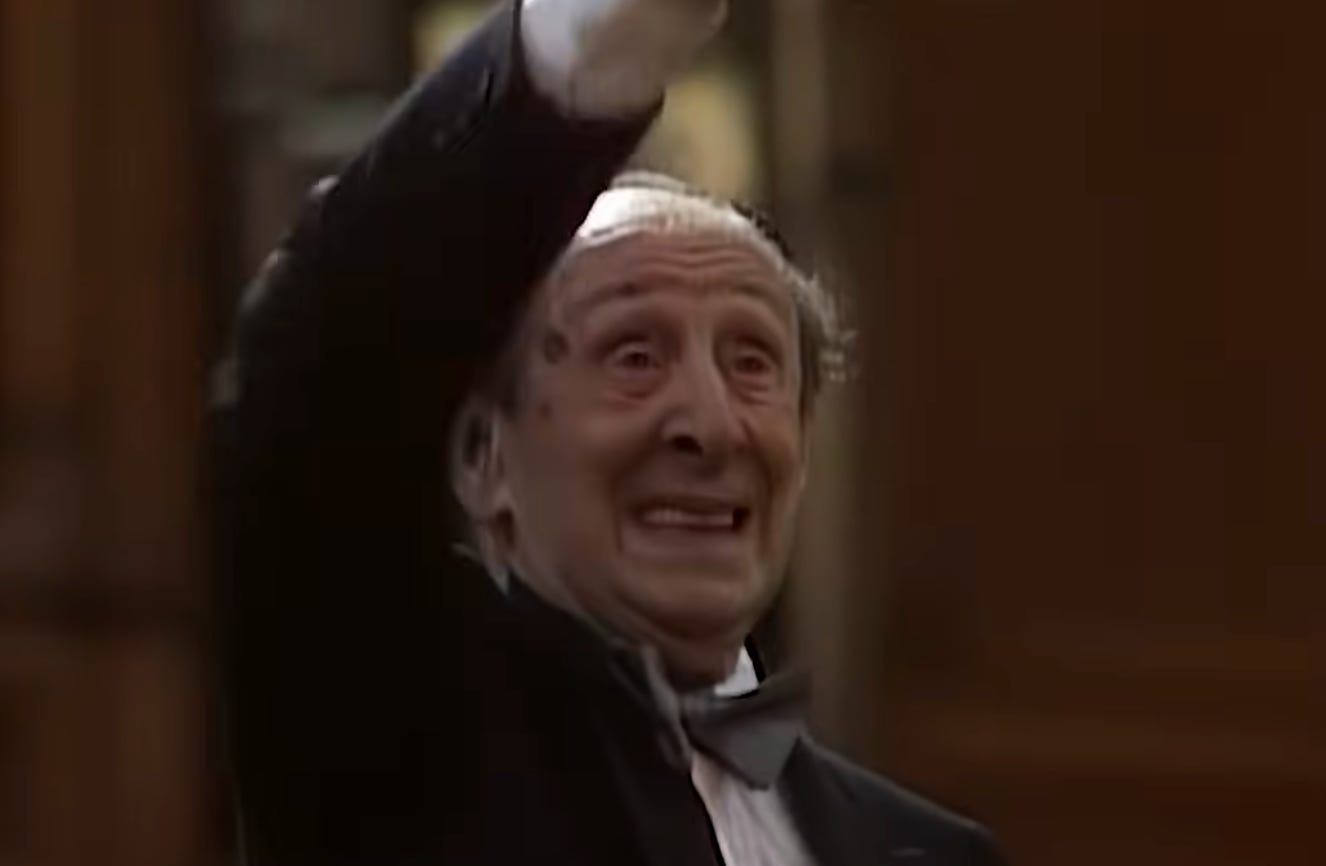
Vladimir Horowitz never forgot. Last week, more than 60 years after that poignant admonition, he returned to the Soviet Union, to the rodina of myth and memory, the homeland of the soul that dwells in the hearts of all Russians, no matter where they live. “I have never forgotten my Russia. I remember the smells when the snow melts and the spring arrives,” says Horowitz, 81. “I had to go back to Russia before I died. It brings an Aristotelian unity to my life, like a coda in music. It is the right time to go back.”
I urge you to read the entire story! I hung on every sentence. Here is the video of the Horowitz concert, which I’m listening to as I write this. Watch it. Watch the great man’s face, watch his hands.
We are having an ugly moment in American life now, one in which hatred of the Jews as a people has come back, as a demon returning from exile in the desert. Watch Horowitz, listen to him, and see if you don’t agree with me: One begins by hating the Jews, and ends by hating civilization itself.
I was almost late to Michael Walsh’s recital last night because I had overslept during my afternoon nap. I’ve been traveling so much lately — three times across the Atlantic in the past five weeks — that I’ve been unable to reset my sleep chakras, or whatever. It’s a common experience that traveling from Europe to America, one doesn’t usually struggle with jet lag, but returning to Europe can be misery. I’m not sure why it is, but it is. I woke up late, threw on some corduroys and a sweater, and, underdressed for the occasion, hustled on foot through the chilly autumnal streets, wet yellow leaves on the sidewalks looking lacquered under the streetlights.
On the way, I listened to Anna Karenina, to those gripping passages in which the eponymous heroine descended into madness. Even if you haven’t read the Tolstoy novel, you almost certainly know that Anna is a beautiful and passionate Russian society woman who leaves her husband and child for Count Alexei Alexandrovich Vronsky, with whom she lives scandalously. Yet she cannot find happiness, and after it becomes clear that the husband she abandoned will not grant her the divorce that would allow her to regularize her relationship with Vronsky, Anna’s inner turmoil overwhelms her.
Here, from the Constance Garnett translation (available for free online; start with Chapter 23 at this link), is more or less how her last torment begins:
The irritability that kept them apart had no external cause, and all efforts to come to an understanding intensified it, instead of removing it. It was an inner irritation, grounded in her mind on the conviction that his love had grown less; in his, on regret that he had put himself for her sake in a difficult position, which she, instead of lightening, made still more difficult. Neither of them gave full utterance to their sense of grievance, but they considered each other in the wrong, and tried on every pretext to prove this to one another.
In her eyes the whole of him, with all his habits, ideas, desires, with all his spiritual and physical temperament, was one thing–love for women, and that love, she felt, ought to be entirely concentrated on her alone. That love was less; consequently, as she reasoned, he must have transferred part of his love to other women or to another woman–and she was jealous. She was jealous not of any particular woman but of the decrease of his love. Not having got an object for her jealousy, she was on the lookout for it. At the slightest hint she transferred her jealousy from one object to another. At one time she was jealous of those low women with whom he might so easily renew his old bachelor ties; then she was jealous of the society women he might meet; then she was jealous of the imaginary girl whom he might want to marry, for whose sake he would break with her. And this last form of jealousy tortured her most of all, especially as he had unwarily told her, in a moment of frankness, that his mother knew him so little that she had had the audacity to try and persuade him to marry the young Princess Sorokina.
And being jealous of him, Anna was indignant against him and found grounds for indignation in everything. For everything that was difficult in her position she blamed him. The agonizing condition of suspense she had passed in Moscow, the tardiness and indecision of Alexey Alexandrovitch, her solitude–she put it all down to him. If he had loved her he would have seen all the bitterness of her position, and would have rescued her from it. For her being in Moscow and not in the country, he was to blame too. He could not live buried in the country as she would have liked to do. He must have society, and he had put her in this awful position, the bitterness of which he would not see. And again, it was his fault that she was forever separated from her son.
Even the rare moments of tenderness that came from time to time did not soothe her; in his tenderness now she saw a shade of complacency, of self-confidence, which had not been of old and which exasperated her.
So lost was Anna in her emotional tempest that nothing Vronsky did, or failed to do, soothed her. I’ve hated Vronsky throughout this entire novel, but in this section of the novel, I pitied him immensely. The woman he loved had drifted out to the dark sea of her own emotions, beyond the horizon; he could not reach her, and she could no longer see the shore.
I entered the performance hall just as Anna, broken on the wheel of her grief and groundless jealousy, was catching a cab for the train station. Everybody, even those who haven’t read the novel, knows what happens next: she throws herself under the train, to relieve her own torment, and to punish Vronsky.
So, this was the emotional state I was in when I took my seat at the recital. Never have I read a passage from literature in which the inner state of a suffering character had been made so intensely real to me. I wanted to stop the story, to grab Anna and tell her, “Don’t do this! He does love you! See reason!” But she was caught in a torrent, and would not be saved. Knowing what was coming, I hated that she was doing this to Vronsky, and to her children. But then, Anna always did put her own happiness above all else. The thing is, reading Tolstoy, this does not come across as the moral choice of a selfish woman, but as the final manifestation of a spirit to which she had given herself over years before, when, in her dissatisfaction with her marriage to the cold martinet Karenin, she yielded to her desire for dashing Count Vronsky.
Many of us have been in a similar place, tempted to end our lives to escape the emotional pain of carrying on under what seems like unbearable circumstances. Tolstoy — my God, could anyone ever match him! — sustains the tension between our knowing how unjustified Anna’s inner crisis is by the facts of her life, difficult as they may be, and how they appear to her from her intense inner isolation. It is agonizing to stand on the bank of a raging river in flood, to see a woman caught in its swirling currents, and to know that nothing you do can save her from going over the falls.
After the recital, it was colder outside, but I chose to walk the long way back to my place, across Pest, so I could listen to Anna Karenina. I was standing at the Oktogon, on Andrassy Avenue, woolen scarf wrapped tightly around my neck against the cold, when Anna ended her life violently. I involuntarily crossed myself at the moment. I will remember for the rest of my life where I was at that moment.
Back at home, I thought about the evening. Franz Liszt and his music — that is civilization, and not just civilization, but European civilization, Western civilization. Nobody else produced Franz Liszt; a particular people in a particular time and place did. Same with Tolstoy. This civilization is under attack now, by no enemies more powerful than the educated barbarians within it, and the indifference of the masses, who have been taught not to care for our patrimony.
Saul Bellow famously asked, “Who is the Tolstoy of the Zulus?” The writer Ralph Wiley responded: “Tolstoy is the Tolstoy of the Zulus. Unless you find a profit in fencing off universal properties of mankind into exclusive tribal ownership.”
That is certainly true! But so too is Bellow’s point: Tolstoy’s unique genius emerged out of a specific people, in a specific place, under specific cultural conditions. It’s not that Tolstoy’s genius was determined by material conditions — think of all the Tolstoys that did not emerge from 19th century Russia — but that Tolstoy’s genius was able to manifest and develop thanks to the culture into which he was born. We will never know the men or women who had Tolstoy’s capacity for genius, but who were never able to express it because they were poor, or female, or what have you.
You might think of it this way: who is the Louis Armstrong of the white Americans? The answer: Louis Armstrong is the Louis Armstrong of the white Americans! He belongs to us all. But jazz music came out of the genius of black people in the United States, in a particular time, under certain conditions. And by the way, do you know why Armstrong wore a Star of David all his life? Because as a fatherless, poor black boy in early 20th century New Orleans, Armstrong was taken in by the Karnofskys, a family of Lithuanian Jewish immigrants, who gave him work, food, a place to stay, and the money to buy his first horn. He never forgot their kindness.
See, this is why I say that if you come to hate the Jews, you eventually come to hate civilization. Most of what we call Western civilization was not the product directly of Jewish creators. But to me, they represent love of excellence, of study and achievement, especially in art, and even, as in the case of the Karnofskys, moral excellence. Of course Jews are human beings like the rest of us. They have as many saints and sinners as we all do. But there is something in the spirit of the Jewish people, as a people, that strikes me as cherishing the life of the mind, and the development of artistic gifts.
I never knew any Jews as a child — there were none in our town — but I experienced myself what it’s like when the mob resents you for doing well. In my ninth grade English class, there was a crass, bully of a girl, the daughter of a prison guard, who made my life hell by mocking me when I would use a word she didn’t understand. In her hick twang, she would say things like, “I cain’t understand a thing he’s sayin’. He’s talkin’ Japanese.” Stupid stuff like that. I know it’s small, and later I would learn that her resentment came out of her own shame at the rough life into which she was born. We became friends, sort of. Still, I have always had a keen sense for what resentment is, and how it manifests.
Look at this man, Vladimir Horowitz, one of the great geniuses of all time. Think that there were raging madmen in power who would have happily sent him to the ovens, simply because he was a Jew. Think too that there are people today, Americans with megaphones, who platform the same kind of scum who would send Horowitz to the ovens. This is serious. This cannot stand. We know where this goes. We can’t not know — and therefore, we cannot tolerate it, nor can we be silent.
Today’s newsletter continues below the paywall. Please consider subscribing — only six dollars per month, for at least five newsletters each week. You won’t like everything you read, but I promise to be honest with you, and the content is usually interesting!
Keep reading with a 7-day free trial
Subscribe to Rod Dreher's Diary to keep reading this post and get 7 days of free access to the full post archives.