
I know, it’s Saturday, and I don’t write on the weekends, but since coming back from the US, I’ve had more than my usual customary trouble re-adjusting my sleep chakras. I’m full of energy this morning, and haven’t even had coffee. So I gotta write, then hit the pavement for my daily walk, accompanied by Donna Tartt reading her smash 1992 novel The Secret History, in her luscious soft Southern accent.
What caught my eye, thanks to Aaron Renn’s Substack, was this piece from the Evangelical magazine WORLD, on why so many young Protestants in America’s power centers are converting to Catholicism. Emma Freire is the author. She makes an important caveat:
ACCORDING TO PEW, only 2% of Americans who were raised Protestant are now Catholic, but 14% of Americans raised Catholic are now Protestant. Former Catholics often say they attended Mass for years and never once heard the gospel. Roman Catholicism loses 8.4 members for each new person who joins, and those numbers might be worse were it not for immigration from Catholic countries in Central and South America. By contrast, Protestantism only loses 1.8 members for each new addition.
While centers of conversion to Catholicism are tiny, they punch above their weight due to their political and cultural prominence.
The point, obviously, is that Protestantism is wiping the floor with Catholicism in terms of overall conversions. But the aspiring power elite are headed the other way. Why? More:
Brad Littlejohn is the director of programs and education at American Compass, a conservative think tank, and co-author of the book Why Do Protestants Convert? He says Washington is the most prominent center of conversion to Catholicism, but that evangelical colleges with a Great Books curriculum also produce converts. That’s because students from “nonliturgical, nonhistorical, theologically shallow Protestant upbringings” get exposed to the great Catholic authors for the first time. Littlejohn thinks that leads to an unfair comparison: “My megachurch youth pastor versus Aquinas is Protestantism versus Catholicism.” Also, Catholic graduate schools like Catholic University, Georgetown, and Notre Dame attract students from Protestant schools, and some of them convert.
Conversion is eased by the fact that it is a less dramatic shift in America than it would be in other countries. American Catholics downplay elements of their theology that might put off Protestant converts. “They make the distinction between, ‘Well, we don’t really pray to the saints. We ask the saints to pray for us,’” Littlejohn said. “That’s an intellectual distinction catering to Protestant concerns that your average Catholic in Mexico or wherever is not doing at all.” Littlejohn notes that Protestant converts also are making their mark on the Catholic Church. They bring a Protestant style of theological reasoning with them, focusing on issues such as justification by faith.
And:
Smith is not alone in looking up to senior conservative figures who are Catholic. “It is undeniably a fact that Catholics are overrepresented in leadership of political and cultural conservative institutions,” Littlejohn said. He cites Ryan Anderson of the Ethics and Public Policy Center and Kevin Roberts of the Heritage Foundation. They are both cradle Catholics. But other famous converts on the right include Vice President JD Vance, controversial podcaster Candace Owens, and former speaker of the U.S. House of Representatives Newt Gingrich. Less recent converts include Richard John Neuhaus, founder of the magazine First Things, and Russell Kirk, author of The Conservative Mind.
Littlejohn argues that once the pattern of Catholic leadership in the conservative movement got established, it became “self-perpetuating.” Today, “anybody who wants to move into that leadership class tends to—subconsciously, at least—internalize that they should be Catholic, too.”
There’s a lot more to the piece, so I hope you’ll read it all. There’s a mention that a smaller number of these young people become Orthodox.
What’s going on? Take my words with caution: though I was raised Protestant, we were not much of a churchgoing family, so I never really encountered serious Protestantism. Besides, our family church was at the time not into serious Bible study, or anything like that. The homilies from our kindly, avuncular pastor were always gentle, and about self-help. As a teenager, I thought “Christianity” meant soft, white-middle-class-at-prayer faith, or TV evangelism. I rejected both, so figured I was an agnostic, or maybe even an atheist.
Then I discovered Chartres, and began investigating Catholicism. I had no idea at all that Christianity could be so intellectually deep, and so beautiful. Nine years after first setting foot in Chartres, I entered the Catholic Church — as a new resident of Washington, DC. What I discovered, to my great dismay, was that the homilies at most Catholic parishes were about like the ones I remembered from my Methodist youth.
I had already started the process of becoming a Catholic before I moved to DC, so Washington had nothing to do with my own conversion. And back then, there was nothing like the robust, intellectually serious Catholic community for young adults that I’m told now exists in Washington. Nevertheless, it did not escape my notice that many of the intellectual leaders in DC and New York that I looked up to — especially Father Richard John Neuhaus — were Catholics. As I’ve admitted before, I developed an intellectually snobbish attitude about Protestants, one I regret. Still, it was hard to avoid the fact that as part of the DC conservative tribe, the smartest people leading the tribe were usually Catholic.
Catholics like to tell themselves that people come to the Catholic faith because they conclude that it is True. Ideally, that’s how it goes, and at some point, that has to be the case. But few conversions, to any faith, are simply a matter of pure rationality — that is, coldly and analytically weighing up the theological arguments. In fact, as I’ve said many times in this space, if your conversion (to Catholicism, Orthodoxy, or Protestantism) is only intellectual, or even mostly intellectual, you are on shakier ground than you realize.
There’s no need to rehash my own happy, then very unhappy, experience as a Catholic. I’ll just say that coming into Catholicism with the idealistic eyes of an intellectual convert set me up for a fall. I expected most of the priests I encountered to be some version of Father Neuhaus, and most of the bishops to be a lesser version of Pope John Paul II. That could not have been further from the truth. That is not a brief against Catholicism, but it is a warning against convert naivete and enthusiasm.
Though I would learn in time that I was wrong to judge all of Protestantism by my own experiences, and by megachurchery — there really is intellectual depth there, is what I’m saying, and besides, you cannot deny many good fruits in the lives of individual Protestant brothers and sisters in Christ — there is zero chance that I would become Protestant. I agree, with Newman, that to go deep into history is to cease to be Protestant. I simply can’t see the Church of the first millennium in Protestantism. Nor can I reconcile myself with the lack of solid interpretive authority in Protestantism. And once one becomes accustomed to worshiping liturgically, with the body, the essential cerebral nature of Protestantism seems like a thin thing, at least to me.
Nevertheless, while I recognize the fact that it’s a normal human thing for people to be drawn to a church or faith tradition that seems like the thing that people who aspire to become a certain sort of person do — when I was growing up in a mostly Protestant local culture, to leave the Baptist or Methodist church for the Episcopal church was seen by many as nothing but social climbing, and in some cases it no doubt was — I still think it a poor thing to join a church because it’s the way to advance one’s life prospects.
Part of my own repentance after I became Orthodox was to reflect on the extent to which my own Catholicism was a bad-faith matter, a case of intellectual and spiritual pride. That’s not the Catholic Church’s fault; that was my own sin. I was a Catholic triumphalist, proud to be part of the Church with all the smart people, and all the beautiful art (never mind Bach and Dürer). Becoming Orthodox in the United States was to join a church with zero political power and no social status. Still is. That’s what I needed.
I’ve learned that in my own hometown, the young Catholic priest there now, a Millennial, is evangelizing and catechizing like a house afire, and drawing converts. Great! I hope this is encouraging Protestant clergy there to step up their game. Casual Christianity, of whatever confession, is not going to survive what’s coming. As older readers of mine might recall, we started an Orthodox mission in my hometown in 2012, but it couldn’t survive, because we couldn’t get converts. Orthodoxy, I think, was just too culturally strange for small-town Louisiana folks. I get it. Sad, but I get it.
Nevertheless, it can’t be a good thing for a society that its leadership class belongs to one church, and the masses belong to another. I did not like Pope Francis one bit, but some Latin American friends who are Catholic, and who share my view of Francis, said he really was onto something in his hostility to elite Catholicism. They have told me that in many Latin American countries, the institutional Catholic Church tends to cater to social elites — which is why Latin Catholicism is losing so many of the poor and the working class to Evangelicalism and Pentecostalism. I’m interested to learn what readers of this newsletter, Catholic and Protestant alike, who have experience in Latin America have to say about this.
I think of something an Evangelical missionary back from assignment in Guatemala told me in my backyard in Dallas once, around 2006: that when he got there, the institutional Catholic Church was dominated by liberation-theology leftist priests, who responded to the “church of the elites” critique by becoming political and theological leftists. He said he went to the local Catholic parish in the area he was assigned to evangelize, just to see how things were going. The priest had allowed an indigenous shaman to perform some sort of occult ritual in the rear of the church while he, the priest, celebrated mass. This, said the missionary, told him a lot about why so many of the ordinary people around there were open to Evangelicalism.
Somebody else, can’t remember who, with experience evangelizing in Latin America for Protestantism told me that poor and working-class men were attending Evangelical churches, and ceasing to drink and beat their wives. There was a tangible social benefit to becoming Protestant — and it wasn’t about getting rich, certainly, but about discovering agency for moral improvement, versus the kind of fatalism they associated with being Catholic.
Here in Europe, I meet serious Protestants and serious Catholics, and it is always a joy to make new friends who share faith in Christ. I have many more Catholic friends than Protestant ones, but I find in general, the Catholics are Catholic in spite of their moribund, and even liberal, church leadership. It’s hard to generalize, especially if, like me, one doesn’t speak the local language. This is just what I’m told.
Anyway, in Europe, to be a serious Christian of any kind is definitely not a path to social or professional advancement. If you are a churchgoing Protestant or Catholic under the age of 60, it’s because you really believe it.
When people talk to me about Orthodoxy, in the context of considering conversion, I tell them about all the great things the Lord has done for me within Orthodoxy, and encourage them to come to church with me. You learn as much about Orthodoxy from observing Orthodox worship as you do from reading books about Orthodoxy, and maybe more. But I also warn them not to make the mistake that I, as a young Catholic convert, did, and idealize the institutional Church. Nor should they put priests and bishops on any kind of pedestal.
I also tell them not to treat their investigation into Orthodoxy as a purely intellectual thing. Yes, obviously you should read about what Orthodoxy teaches, and consider it seriously. But more than any other version of the Christian faith, Orthodoxy emphasizes the reality of Mystery at the heart of faith. It emphasizes knowing not simply as an intellectual exercise. In English, we suffer because we have only one word for “to know”. In French and German, for example, there are different verbs for to know: “savoir” and “wissen” are to know intellectually; “connaître” and “kennen” are to know personally. You “savoir/wissen” a fact, but you “connaître/kennen” a person.
Orthodoxy is more about the personal sense of knowing than the abstract sense. It’s more right-brained than left-brained, in other words. That’s not to say it is exclusively right-brained — it definitely is not, and if you want a sense of the depth of Orthodox theology, try this rich book on Orthodox spirituality by the recently canonized 20th century Romanian Orthodox theologian Dumitru Staniloae.
The point I’m trying to make here is that Orthodox spirituality is primarily (but not exclusively) experiential. I think of a funny story the godmother of contemporary American Orthodoxy, Frederica Mathewes-Green, told me once: that she found herself at a coffee break during an ecumenical conference, and all the Orthodox and the Pentecostals ended up on one side of the room discussing worship, while the Catholics and the Calvinists were on the other side of the room discussing doctrine. It’s a cute story, but there’s a lot of truth in it, about actually lived Christianity.
Back to the WORLD story, I think it’s undoubtedly the case that intelligent, ambitious young people in a place like Washington are drawn to Catholicism because it gives them a profound, systematic, and holistic way to think about how to live as a Christian in the world.
I think about a brief Evangelical phase I went through when I was twelve or thirteen, and my mind was on fire from having read The Late, Great Planet Earth. This would have been around 1980. I asked my mom to start driving me to our town’s Southern Baptist church on Sunday mornings, because the Baptists seemed to me to be the only ones really engaged with trying to get people saved. Wasn’t that the most important thing, given that the Antichrist was just around the corner, and the Rapture could happen any day now? I admired Brother Jack, the pastor, for ending every sermon with an altar call. Even today, I admire that about the Baptists: the emphasis they place on the importance of making a personal decision for Christ.
I see now that the altar call was for them what the act of communion with the Eucharist is for the liturgical churches: the summit of worship. What do you do after you have made your decision for Christ, and publicly declared it? All that was so long ago, and I hesitate to criticize what I only experienced as a young teenager, but it seems to me that if all, or most, of your energy goes into evangelizing the lost, to get them to that moment of conversion, it’s hard to find space to think deeply and broadly about what it means to be Christian in the world, in the way Catholics (and, I think, many Calvinists) do.
It is also the case that Catholics have a far more developed intellectual system than we Orthodox do, regarding things like “social teaching.” This is a reflection of the Western mind, and it has its strengths and weaknesses. Its strengths hardly need elaboration, but its main weakness is that it can become easy to think of the point of Christianity as organizing the world according to a religious schematic, forgetting that nothing matters without the ongoing communion with the Holy Spirit. On the other hand, one reads stories about Orthodox priests in 19th century Russia who barely knew how to read, and who were present simply to provide the sacraments to the poor. One reason I got fed up with the Catholic Church at the height of the scandal was because my experience of it, in my time and place, was that it was treated by the clergy as a “sacrament factory”. Well, could one not say the same thing about those woebegone peasant Orthodox parishes in 19th century Russia?
I’m finishing today one of the most amazing, and uncategorizable, books I’ve read in ages: The Edges Of The World, by the Oxford scholar Charles Foster. It was just published in the UK, and if there’s any way you non-British readers can get a Kindle copy of it, please do! I intend to write about it, but I swear I don’t know how — it’s so weird and wonderful and thought-provoking that I hardly know where to start. It’s about the experience of “edginess” — of living at the border of experiences. Foster is an Orthodox convert, but this is not really a religious book. Nevertheless, he opens one chapter with this epigraph:
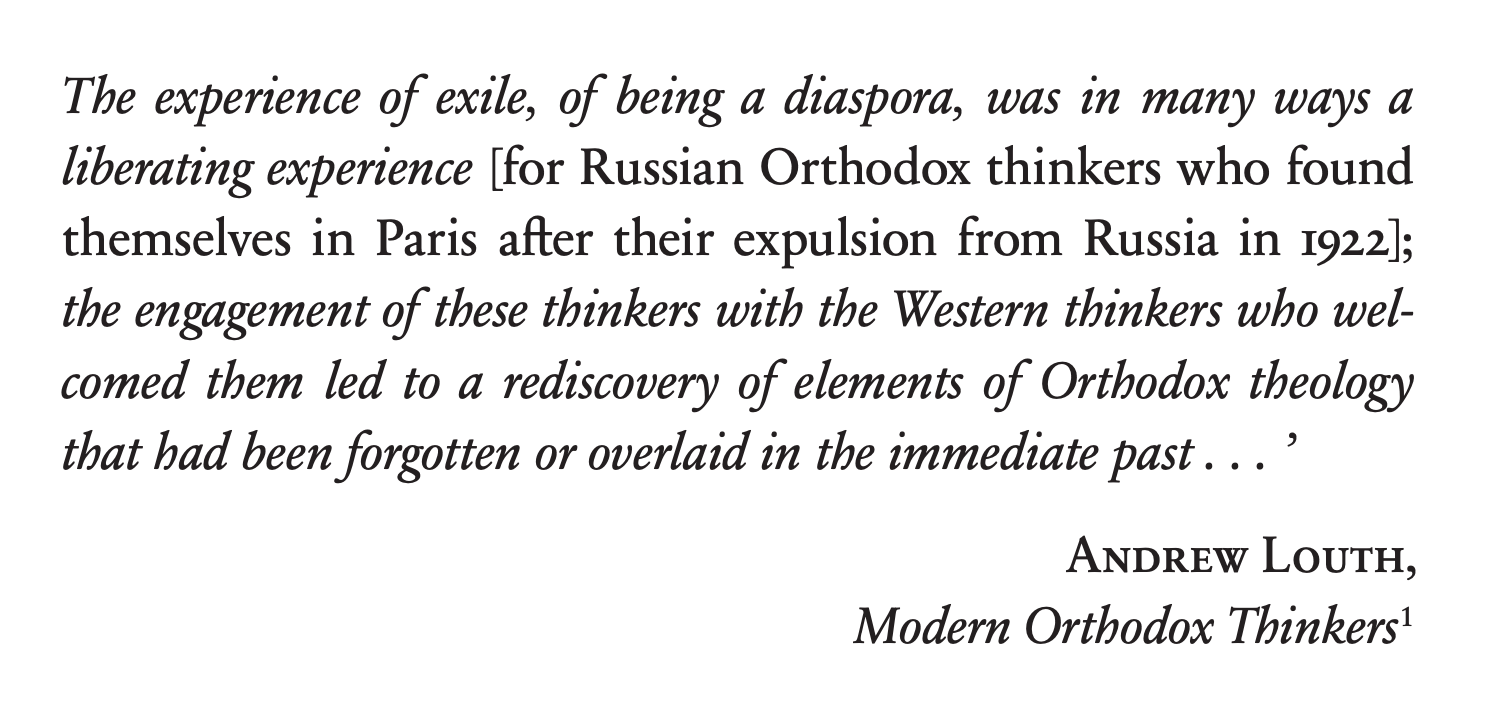
This quote captures one of the blessings of crossing the border from one religious tradition to another (or, within the same tradition, encountering it in a different, unfamiliar place): it can cause one to reflect on things long forgotten that ought to have been remembered. Converts to Catholicism and Orthodoxy can come across as pains in the ass to cradle members of those communions, in part because they show up with a certain idea of how the parish should be, and are impatient when they find that the parish is full of people who don’t know what they’re talking about. This is a reminder to converts to be humble, to listen instead of talking. I’m not justifying the settled, comfortable, sometimes heterodox ways of doing things within long-established parishes. I’m rather saying that if converts who have discovered “elements” of the tradition that have “been forgotten or overlaid in the immediate past” want to re-awaken the somnolent cradles to these things, they need to first be humble and get to know the people, in all their virtues and limitations.
Nevertheless, sincere converts who have crossed that border can, at their best, see things within their new tradition with fresh eyes, and can illuminate treasures that old eyes have forgotten how to see, and to love. When I was a Catholic in the 1990s and the first half of the 2000s, it was common for us converts to talk among ourselves about how amazed and disconcerted we were to encounter cradle Catholics who didn’t know or didn’t care about the amazing treasures they had in their Catholic faith! As I recall, we didn’t say that in a judgmental way, but rather in a “can you believe what they have, and don’t even know?!” A wise and charitable convert can awaken within slumbering cradles an awareness of these things, and kindle a desire to reclaim them.
One more thing about edginess. I’ve really been down since returning from Louisiana, and having to face the enormity and finality of my own sense of exile. Again, for the sake of protecting their privacy, I can’t and won’t tell you the details of what is going on, but suffice it to say that I know now, without a shadow of a doubt that I am an exile, and will be from here on out. It’s a terrible story, a tragic story, an incredibly stupid story (because it did not have to happen) … but ultimately, an all-too-human story. Where to go from here? If you are one of the people who somehow think I’m enjoying some sort of romantic holiday living in Europe, darling, let me disabuse you of that. I am grateful for my life here, but I would not have chosen to come here under these circumstances for anything.
Charles Foster’s book, though, stimulates me to think about what I might do creatively to make the best of living on this edge, to redeem this awful situation of brokenness and rejection. It will not surprise many of you (and will exasperate some) that Foster’s book sends me back to reflecting on Tarkovsky’s film Nostalghia, which is about a Russian writer trying to get comfortable with living in Italy, however temporarily, though he is haunted by nostalgia for Russia. One key part of the movie is the impossibility of translation, of expressing the same thing in different languages. The movie — it’s a densely symbolic film that resists easy analysis — seems to resolve the question by saying that the problem is ultimate irresolvable in this life, and the only way to respond to it is to stop thinking about it, and instead to pay attention to what is in front of you, and act with sacrificial love.
It’s a very Orthodox way to approach the dilemma, actually. (Tarkovsky’s religious beliefs were always in flux, but he was definitely a spiritually deep artist.) The differences among us humans, with our own individual souls, shaped by our particular cultures and circumstances, will never be fully reconciled in this life. You can make yourself very unhappy if you perseverate on this, the film seems to say. But love, true love, really is the universal language, one that crosses borders and edges, and takes us as close as we can get to living in harmony, within the limits of time, place, and difference.
That is hard-won wisdom for me, in my religious journey through life. The worst kind of Christians are those who are snide and triumphalistic about their faith. When I was Catholic, I was proud to be Catholic; now that I’m Orthodox, I’m grateful to be Orthodox. Again, the change was within me, after my total humiliation as a prideful Catholic (once more: this was my sin, not the Catholic Church’s; I’ve met Protestants and Orthodox who are just like I was as a snotty Catholic). I’ve never met anyone who was shamed or insulted into joining a particular church, or returning to one he has left. If you believe you have found something better in Catholicism, Protestantism, or Orthodoxy than what you had before, for God’s sake don’t be a jerk about it. That’s pride talking, and it wins no one to your side, and might even destroy you.
No matter where you are, or where you end up in ecclesial terms, if you don’t have love — of God and of your neighbor, even your neighbor of a rival tradition, or no tradition at all — you are doing it wrong. Love sometimes requires one to make hard decisions; it is not the same thing as sentimentality. When Catholics tell me they are praying for me to return to the Catholic Church, I can always tell when they’re doing it out of sincere love, and when they’re doing it out of a sense of “bless your heart” superiority. I’m not going to become Catholic again — I really love being Orthodox — but I accept the sentiment from the former in the sense of charity with which it is meant. If they believe that my soul really is in danger by my not being Catholic, then it is an act of love for them to urge me to reconsider my path. I am not offended by this, though I sometimes respond by asking them instead to pray that I follow the Lord’s will in all things.
Anyway, about leading with love, I do it wrong every day. Boy, do I. But I’m trying to get better. Honestly, I am, though it might not seem like it. I had some very hard words with my mom this week, but I did so out of love — desperate love, actually, the love of a son who wants what is best for his mother. She did not receive them as such, but then, my sweet-natured mom (imagine Edith Bunker meets Dolly Parton) has always believed that personal happiness is the only measure of the Good. If I were a heroin addict, she would probably send me money for smack, because it made me happy. For her, to love her is to approve of everything she does and desires, because it makes her happy. Lord, life is such a difficult thing, isn’t it?
The thing is, I’m basically a hobbit who thinks he’s an elf, and who tries to transmute the elf virtues (intellectualism, aestheticism) into his temperamental hobbitness. Beer helps, brethren. So does good food. Speaking of, I think I’ll head off to the covered market on this cold Budapest morning and get the fixings to make a thick stew, to ward off the bleak midwinter blues, which, I gotta tell you, seem pretty overwhelming this week.
By the way, if you’ve never seen the long Pints With Aquinas interview Matt Fradd did with me, you might find it interesting. It was the best interview I’ve ever had, in terms of enjoying the conversation. Fradd, a Catholic, is such a great person to talk to. Next week at this time, I’ll be in Oslo, talking to a group of Lutherans. It is always good to gather with Christians who really believe. That’s how I roll these days. Too wo’ out to do otherwise.
At age 25, I converted from serious Protestantism—as a devout Evangelical—to Roman Catholicism. I had been raised to believe Catholics went to heaven but were taught major error, hence the necessity of Protestantism.
My conversion was **both** intellectual and experiential. I want to stress that.
The first time I attended Mass was as a graduate student on TCU's campus. When the Nicene Creed was recited, I simply knew. The article we're discussing, written by an Evangelical, claims "Former Catholics often say they attended Mass for years and never once heard the gospel." They can say that, but the Nicene Creed *is* the gospel.
(Of course, no offense intended to brothers and sisters in Christ here who are Protestant.)
Intellectually, I knew my choice: Remain outside, protesting imperfect teaching, or, recognizing no church is perfect, join the original church (yes, I knew the history). Experientially, I knew from the first Mass that Christ is really present in the Sacraments. I loved His presence. Yes, He is omnipresent, and yes, He comes into hearts in a special way for all who accept Him, Catholic or Protestant alike. But His Real Presence in the Sacraments, such as the Eucharist, was something I knew experientially. My Baptist and later non-denomination Charismatic upbringing did not teach this, nor invoke His presence in Sacraments.
The day after that Mass, I bought City of God. I realized there was a whole world of saints and tradition I had missed. After completing the initiation classes, I was received into the Catholic Church.
Born, raised and educated Roman Catholic, got disillusioned for a couple decades, tried Presbyterianism with second husband, now deceased, and stumbled into a tiny Orthodox church in town. Feels like home. Need the sense of permanency, the unapologetic respect for tradition, the recognition that fasting and regular prayer times are necessary, and the humility and concentration on repentance. Finding Christ is a heart thing, not a brain thing.
One problem I observed while Protestant was the flexibility one could have. People jumped from Presbyterian to Baptist if they didn’t like the music. I had never heard of church shopping. It seemed what was important was that they enjoy themselves and the service was at a comfortable hour for them. Another was how weird some of Luther and Calvin’s ideas were. What an unloving God they imagined. No free will, predestination. I told the pastor when I joined that I could not accept these ideas and if I needed to to join, it was a deal breaker. But he said, no problem. There’s that surprising flexibility again. It was weird that Christianity seemed to have started in the 1500s. No Mary, no saints, just lots of NIV bible. Salvation was a one- day event. Confession was 30 seconds of silence during Sunday service and eucharist was once a month.
Anyway, since my husband’s passing I am free to pursue my Orthodox chrismation. The congregation is tiny but full of young couples and kids. Like you, Rod, I’ve endured some seriously painful family losses and estrangements. I struggle with anger and resentment too, and know I’m sinful and need to get past it and forgive. It’s so hard, this sense of betrayal. Anyway, I find this little congregation welcoming, non judgmental, and not pressing me for all the ways I can volunteer. I’m immersing myself in the rituals and traditions and trying to fathom theosis. Using my heart, silencing my aching brain.
Having discovered your writings a while ago and learning of your path to Orthdoxy has been an influence too. Thank you.