Houston: 'I'm In Here'
The Incredible Story Of A Severely Autistic Mystic & His Enchanted World

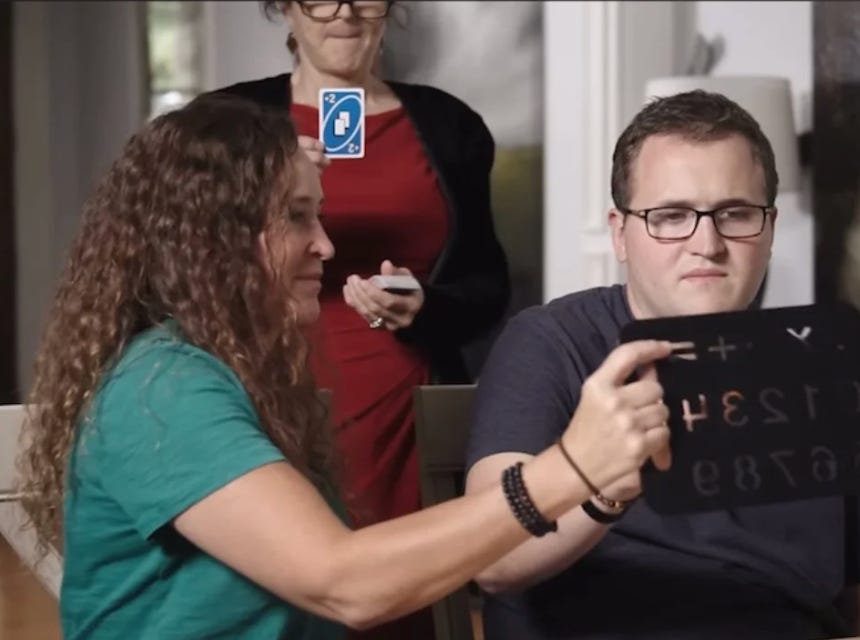
Strap in, readers, today’s newsletter is going to be a strange journey. It started with my listening to the first two episodes of The Telepathy Tapes, but I have received private warnings from several of you that I should not continue. Your reasons make sense. They have nothing to do with the idea that the phenomenon documented in the podcast series — the seemingly paranormal abilities of the severely autistic — not being true. They are true. This is real. I don’t want to say more, but I have stopped listening to the podcast.
One of you readers knows Katie Asher, who is featured in the podcast with her son Houston, pictured above. Katie reached out yesterday to send a PDF of her book titled The Book of Heaven. It’s about the spiritual journey of her and her son Houston. It is one of the most incredible books I’ve ever read. It will change the way I pray. To give you an idea of how powerful this book is, I can tell you that I spent nine hours straight reading it yesterday, finally putting it down at 3 am because my body was too tired to continue. You know that I’ve been suffering from mononucleosis, but the narrative was so astonishing that I forgot my deep need to sleep. I finished it this morning.
I want to tell you about it. I can’t do justice to this book in a single newsletter, but I will try. Before we start, let me say that I’m going to be wrestling with the things I learned in this book for some time, to make sense of them. Don’t read my writing about it here as saying I affirm everything in the book. Maybe I do, or will; I don’t know yet, because I have to think and pray about it all. (And there is intense scientific skepticism about the spelling board method, just for the record; here is a link to an article debunking the claims made on The Telepathy Tapes, including Houston’s case.) It is fair to point out that I came at this book holding a set of convictions about the nature of reality that makes its claims at least plausible. It is also fair to point out that materialists come at this information holding the opposite set of convictions. I have an atheist friend, for example, who has an “explanation” for any paranormal thing I present; this friend is as much a person of “faith” as any Orthodox monk.
But anyway, look, I want to introduce you to a book that came as a gift, in ways that maybe Katie Asher did not intend. You make up your own mind. Let’s begin.
The Book of Heaven is long, and hard to read in its first half, because it tells the story of the at times unimaginable abuse and hardship Katie has lived through. It started in her abusive childhood (I kept thinking, we who have had good childhoods have no idea what so many children suffer behind closed doors), and continues through her marriage to a man so abusive his behavior can only be described as satanic. This man, whom she calls “Big Jock,” is the father of Houston and his siblings.
Houston is profoundly autistic, and non-verbal. The hardships of raising him, especially as a single mother (Katie finally left her brutal husband), beggar belief — except to those who know something about what it’s like to live with autistic children. One of my children was diagnosed with high-functioning autism when he was seven. Though he’s fine now, his childhood was pretty rough, though nothing like Houston’s — though there were enough similarities that sometimes I found myself nodding, saying, Yes, that’s how it is. I testify that my ex-wife, his mother, sacrificed herself over and over to help our boy. Nothing that happened between her and me after that can take away that maternal love in action. In fact, it only compounds the tragedy that befell our family. But that is not a story that is my right to tell.
Houston’s story turns around Chapter 32, when, then 21, he began to communicate. What happened was this: Katie learned of a method that allows non-verbal autists to “speak” through pointing to letters on a board. It turned out that Houston was a fully formed adult, with an extraordinary mind, trapped inside a body that he could not control. One of his earliest messages was: “I’M IN HERE”.
It turns out that he had been “in there,” fully developed, the whole time, but had no way of getting the words out. All the medical testing had shown that Houston at best had the mind of a small child — but it wasn’t true. Over the course of the narrative, Katie shares this method (which she learned from another family of a non-verbal autist) with other families, who are amazed to discover that their non-verbal kids were “in there” the whole time.
But there’s a lot more. It turns out that Houston (like other non-verbal autists, such as those featured in The Telepathy Tapes) can read minds. More than that, it’s as if the veil that lays over us “neurotypicals” that keeps the spiritual world hidden from us doesn’t exist for him. At this point I should say that Katie is (or was when she wrote the book) a Presbyterian, though being hurt at church kept her away from services for some of Houston’s childhood. Yet so much of what she would learn from Houston after the door of communication was unlocked is wonderfully resonant with Orthodox Christian metaphysics and theology! You’ll see.
All of this came pouring out of Houston after he was able to communicate with the spelling board. It is claimed by skeptics that these autists are not really communicating, but rather being subtly guided by their “handlers.” Either Katie Asher has concocted a hysterical fantasy, or it’s real. Her son communicates things to many other people, including things his mother (his helper) couldn’t possibly know. For example, though only having been taught simple math, he solves a quadratic equation for someone testing him. Katie doesn’t know that math. Plus he knows things about people around them that he could only have learned if somehow he had access to their thoughts.
Houston is profoundly Christian, and says that he sees angels, sometimes demons, and that he has visited Heaven, and spoken with Jesus. Houston says Jesus told him that his task in life is to be his (Christ’s) “herald.” It’s a mission he takes seriously. In the narrative, when Katie tells Houston she’s thinking of writing a book about his story, he tells her he will only participate if the book is about God, not him. The book is true to Houston’s condition.
Before the communication breakthrough, Katie’s faith was ground down badly by the hardship of raising a severely autistic son, as well as four other kids, while also dealing with a staggeringly abusive ex-husband who withheld child support. Though she was a Bible-reader and churchgoer, she became alienated from the church because she kept dealing with people who treated the faith like it was a series of theological propositions that undergird a comfortable, middle-class life. She felt unseen — that she was drowning in overwork, stress, and pain, but nobody at church saw her, or wanted to see her. He and her son’s suffering seemed to make people uncomfortable, so they looked away. She felt forgotten by God.
I had been taught a very strict doctrine of sovereignty and predestination since I was a child. I knew there was suffering because of sin. I knew God used what He hated to accomplish what He loved. I knew the Scriptures. I knew the logic. I knew the theology of Isaiah 55:9 Job 1:21, unanswered prayers. I make these statements so that any of you who like to discuss theology as a pastime to show others your intellectual prowess instead of actually living the enormous implications of this paradox when life has been wicked and cruel, will actually give me the benefit of the doubt that I know what you’re going to say. Please, please try to not intellectualize this. Please don’t quote scripture. I am talking about my heart and its deepest longings. I am talking about watching my son be tormented in front of my eyes for decades and being unable to stop it. I am talking about crying out to God. I am talking about the silence and what I scream into it.
She goes on:
I sadly acknowledged that the church didn’t teach how to have faith or hope beyond salvation at all, unless of course, it was the teaching on tithing and testing God to open up His abundant storehouses. Then they would teach profoundly about the power of faith. But in response to pain, loss, suffering, or injustice, the church taught acceptance. It taught how to experience suffering as holiness.It taught how we deserve nothing good. It taught against complaining and grumbling. It taught to grin and bear it.It taught God doesn’t want us to be happy, just holy. It taught how to trust there was a greater purpose beyond our ability or wisdom to see, which meant that no matter how horrific, this was ultimately good for you. It taught God uses what He hates to accomplish what He loves. It taught sovereignty and submission. And it taught how to just hold on until you die.
A word here. It is true that we have to accept our crosses, and that we do have to trust in God’s sovereign will. And Katie does that, still. What she’s talking about is that she never was given hope that God might actually heal, and that God wants us to experience His overwhelming love, not conceptually, but actually, and transformatively. She describes her faith as having been about punching your ticket for the afterlife, and then huddling around and enduring whatever pain life throws at you, hoping to bear it faithfully until death.
Then came Houston’s release, which began with a “chance” meeting in a Chili’s with a meeting of another family with a nonverbal autist. (Katie believes this was a God thing.) They told her about the spelling board. Houston then appeared in their lives as a fully formed adult, speaking through the keyhole of the spelling board.
But also more than that. The family had to cope with evidence that he could read their minds, and the minds of others. For instance, they learn that he had “read” all the Harry Potter books, not because he literally read them, but because he experienced his sister Morgan reading them. There were practical problems with this. For example, Houston would beg his mom to cut off access to YouTube, because he felt compelled to watch videos and stim to them, as an addict (Houston calls this an addiction, because that stimulation gives him a high). But he kept figuring out how to break the passwords, until the family realized that he was reading it on their minds. Then they came up with a new way of using passwords that enabled them not to hold the passwords in their minds.
In the narrative, Houston meets other nonverbal autists, and they communicate telepathically. Katie also observes how dogs behave differently around him, as if they can trust him, and can communicate with them. Houston says they can. This reminds me of the many stories in Orthodoxy about how saints, at advanced levels of contemplation, live peacefully with wild animals, even bears.
The most interesting — and theologically challenging — claims made by Houston are metaphysical. He says that thoughts are not insubstantial, but forms of energy. This is why prayer works, he claims.
I don’t want you to get the idea that Houston and Katie just drop these theological and metaphysical claims on the reader. It’s a long book; I’m compelled by the short form of this newsletter to get to the nitty-gritty.
What Houston presents, over the course of the book’s second half, is his experience of reality as non-dualistic. That is, all things are ultimately energy (which physics tells us is true), and that the boundaries between the seen and unseen interpenetrate, and act on each other. This is all Eastern Orthodoxy 101, but it is mind-blowing to the Protestant mom of Houston.
Houston can identify certain places and objects as having “good energy” or “bad energy.” As Presbyterians, they lack the conceptual language of “blessing” and “cursing,” but that’s what he’s talking about. At one point, Katie comes to realize that the world really is sacramental, that there is no such thing as “dead matter.” Everything is charged with spiritual energy.
The part I found hardest to make sense of is Houston’s belief that various stones (crystals, etc) are holders and transmitters of energy. That’s too much woo for me to accept. That said, as an Orthodox Christian, especially one who knows a lot about exorcism, I know well that blessed and cursed objects have real-world effects. What is hard to make room for, in my model of reality, is that stones themselves contain properties that modulate energy.
Houston resonates with magnetic hematite, but he loses his stones. Then:
Houston needed more. I didn’t ask him what I should do, Ijust drove us to a local shop that sold stones so Houston could choose new ones. It was weird. I walked the aisles with Houston asking if he saw any he wanted. Strangely, he didn’t seem interested in anything. I asked the manager if they had any magnetic hematite. The manager was surprised when he realized they had none. I stood in the middle of the shop and held up the board. Houston spelled, “My angels are holding out their wings blocking me. Esther said not to touch anything. There are idols in this place. There is evil here. Take me home now.”
It turns out that this was a New Age shop that had idols in the next room. There’s another anecdote in which they visit a friend who has a machine that produces frequencies that supposedly manifest things you want. Houston freaks out severely and begs his mother to leave, saying there is evil there, coming through that machine. He tells his mom, “Getting a portal was stupid.” The friend, a Christian, threw the machine out.
“Esther” is Katie’s long-dead relative, a passionate Christian about whom Houston had never known. Houston says that Jesus gave her to him to look over him and guide him. Houston makes claims about the Virgin Mary and the saints that would scandalize a Calvinist.
Kari asked Houston to share about Jesus and Mary.
Houston: “Our thinking does not have a lot of the saints. The truth, even the saints mean something in heaven. It is good sharing the work of the saints.”
Kari: “And Mary is the queen of the saints!”
Houston: “Yes.”
Kari (excitedly with exuberant joy): “Yes, she was the first disciple and taught us how to follow and love Him.”
Kari asked Houston to share about his interactions with Jesus. Houston: “The way He talks to me is with preaching the Word to me all the time. Our sharing the story that Jesus wants to share gives Mary the love she deserves….”
Back to the stones thing. Katie becomes involved with a Christian who says she uses energy to heal. She writes:
With a cross on her neck and the love of Christ in her heart, Grace taught us how to become aware and in tune with the information our spirit was sensing around us, to quiet the analytical and listen to the spiritual, and mostly to trust what our spirit sensed. This was difficult for a Presbyterian. Presbyterians had rightfully been dubbed the Frozen Chosen of Christendom. Knowledge was their pride and focus. Sensing was not a skill I had ever been encouraged to develop. So with trepidation, I began to learn the art of listening, sensing, and trusting, instead of scrutiny, dissection, and proof.
Again, I’m not quite sure how to take this. As an Orthodox Christian, I completely believe that the core of religious experience is what the Catholic scholar Marshall McLuhan called “percept” — that is, perceiving God and spiritual realities. As you longtime readers know, one of the big reasons I lost my Catholic faith is that my experience of God was way too much in my head. Orthodoxy has helped heal me because it has taught me that while the head is important, our heart (meaning our noetic, spiritually perceptive faculties) are more important. You don’t develop those by thinking and studying, but through prayer, fasting, and spiritual work. But as for “energy healing” in a Christian context, I just don’t know what to make of it.
Katie:
Energy, I learned, was simply the movement of information, codes, and frequencies, which create oscillations that are vibrations and patterns that relay information. Because of Houston’s sensitivity to stones I started there.
Houston says that thoughts are forms of energy, and the reason he can read other people’s thoughts is because his brain can receive and decode that energy.
That first night in bed, as I processed the miracle I had just witnessed,I suddenly and abruptly realized - Oh my word. They were right! Thoughts are things! They are as real as anything else, as real as a sound wave or a radio wave or a Wi-Fi signal and as real asthe smell of a rose. Houston’s brain just happened to be able to receive, but the thoughts were always out there traveling, moving matter in one way or another. There was no filter, no division between his conscious and subconscious.
I realized how it was too much. Too much for anyone. Too much physically, emotionally, intellectually. For twenty years he had been standing under a Niagara Falls of input from the world and deprived of a way to process, share, explain, and ask for help. And yet, he was still kind. Who but God or someone who has seen God could operate aware of everything, even the worst things, and not retreat? In wonder I sat there—complete awe mixed with a thousand realizations all at the same time. I started thinking about all the books I had read about thought and belief that I had taken at face value. Before that moment I just thought it was something mystical that somehow affected the material.
Then it hit me. Prayer! That must be why God said prayer with faith worked, why He repeatedly said it was your faith that healed you. Because thought was a real thing, an energy or force of some kind, and belief in His promises was the driving force behind it. The implications were enormous.
Houston goes on to tell her that he sees mathematics around us all the time — literally, not conceptually. What he’s talking about, I think, is divine order and harmony throughout Creation. He perceives it directly. Reading his statements about this, it seems to me that what we call “spiritual warfare” is Satan and the demons trying to disrupt that harmony, and to stop the flow of God’s love throughout Creation — both material and immaterial.
This incredible teacher asked him months later to comment about the experience [of solving a quadratic equation when asked]. Houston spelled, “Most of my life numbers would talk to me. The numbers are interposed in the world sort of like forces going on behind the scenes. I see them leap to move with all the movement that uses power. Really, the entire world is numbers orchestrating power. Good power finds numbers and equations that prove themselves true. Numbers tell so many stories. Creating work to sort out all the numbers is putting equations together so we understand the power used to move matter.
I commented: “Core beliefs are very important to Houston. He tells everyone, ‘Core beliefs are everything.’ Houston, Why are core beliefs so important with angels?”
Houston: “When you start to deliver your torn heart to Him, God will make His most wonderful angels work to hold you in their arms. The doubt prevents our angels from helping us.”
More:
Something in me wanted to understand more deeply the power and importance of energy in a way that resonated beyond the physical to the innermost layers of the spirit. Houston told one of his therapists who came to help us with his vestibular program, “God is here. He is everywhere. Energy is everywhere. It’s in everything.” He said it with the certainty of someone who sees it every day. Energy, I discovered, really was everywhere.
This makes me think. According to Eastern Christian metaphysics, God is everywhere in his “energies.” This is a key concept in Orthodox theology. St. Gregory Palamas makes a distinction between God’s “essence,” which is unknowable, and his “energies,” which is how we experience God. This means that God is truly, personally, and immediately present and active in creation through these energies. We participate in the life of God through opening ourselves to these energies through prayer, the sacraments, and works that unite us with God’s will. The more open we are to these energies, the more our fallen nature will be transformed into the likeness of Christ. We can become like God, without becoming God. It’s like when you go outside on a sunny day, you are experiencing the sun in its energies, while the sun itself — the source of energy — remains 93 million miles away, and untouchable.
It seems like this mystical Presbyterian young man with severe autism has discovered something about the way reality is constructed that the Orthodox church fathers already know. The gifts these autists display are a lot like the spiritual gifts that advanced ascetics on Mount Athos and in monasteries have.
Prayer, he keeps telling his mother, is not simply a matter of making requests to God and hoping that He will fulfill them. It literally moves energy fields. But — and this is a big but — you have to believe it will work for it to work, in most cases. Houston keeps saying, “Core beliefs are everything.”
It’s not the case that God will not help people who don’t believe, it seems, but rather the case that prayer typically works like a transfer of energy. If you don’t have faith — if you don’t believe it can happen — then it is unlikely to happen. God is not a machine, and he has not built a machine-like universe. One’s subjective consciousness is part of the system.
Houston often talks about “the Book of Life,” which as we know appears in Scripture, particularly in Revelation. But Houston is not talking about the Bible, nor is he talking about a volume that St. Peter will open at the end of time to see if our name appears on the ledger. Rather, the Book of Life is this (the words are Houston’s):
The BOOK of life, His will, is always working our will to lord ourselves to carry out His will to work our good.
It is interesting that the Book of Life, as this young man sees it, is a symbol for God’s will. I am reminded of these verses from Dante’s Paradiso, about what the pilgrim Dante comes to understand at the end of his journey, as he is standing before God’s throne (from Canto 33):
O grace abounding, through which I presumed
to set my eyes on the Eternal Light
so long that I spent all my sight on it!
In its profundity I saw—ingathered
and bound by love into one single volume—
what, in the universe, seems separate, scattered:
substances, accidents, and dispositions
as if conjoined—in such a way that what
I tell is only rudimentary.
In other words, all things that ever existed are unified in the Book of Life — but Dante can only see that through the eyes of grace. Separation is a temporal illusion.
And so, according to Houston, is time:
When I had some time, I asked Houston what I had been wondering. “Houston, how much do you see what hasn’t happened yet?” He spelled, “Time is all happening at the same time. The angels open windows to let me see some things. Other times they tell me.”
There’s much more in this book, but this is basically it. What The Book Of Heaven taught me is that, if what Houston says is true, then the idea that the brain is not the generator of consciousness, but a receiver of it, is true. The brains of severely autistic people are damaged in ways that leave them unable to control their bodies, and overwhelmed by sensory stimuli, but this also renders those brains unusually receptive to consciousness and energies that normal people (“neurotypicals”) cannot perceive. Houston has synethesia, and also claims to be able to perceive the auras of people, which correspond by color to the state of their minds and souls. People who are mired in depression or sin have darkly colored auras. Those in a state of holiness are bathed in blue — and the holiest are bathed in purple. Houston says purple — the color of royalty — is the color of the garments Jesus wears in heaven.
More importantly, this book is going to change the way I pray — indeed, it already has, today. It made me realize that without knowing it, I’ve been pretty much praying as Katie did before Houston was able to communicate with her. I pray, and hope that God will deliver me from my sins and sufferings, but I don’t have a lot of expectation that He will. I lack faith. Or, to put it another way, I am like the Presbyterians she criticizes, expecting that the best I can hope for is that God will give me the strength to endure until the end.
That’s not nothing! At several points, Houston tells his mother that God allows us to suffer at times to teach us how to love, and how to put everything aside but our trust in Him. Houston keeps saying that love is the only thing that really matters. He’s not saying it in a woolly, happy-clappy way, but rather speaking of God’s love as Dante did: as the force that moves the sun and all the other stars. It is not just an emotional quality of the Godhead, but is an actual energetic force — indeed, the energetic force that gives life to all things.
Like I said, learning how to suffer is an important part of the Christian life. The problem, though, is when you conclude, consciously or otherwise, that life is nothing but suffering, and the best you can hope for is to just bear it. Reading this book made me understand that that’s pretty much the mindset I’ve brought to prayer. It has sustained me through hard times, and indeed sustains me now. But Katie Asher says God offers more for us — but we have to pray with more faith. I have a sense that my doubt — specifically, my sense that I don’t really deserve more than the strength to just hold on — might have something to do with why I feel so stuck.
Katie writes:
We didn’t act like we were loved. We didn’t act like living without fear was even possible. In fact, that was a foolish thought. Trauma after trauma befell and we just kept running for shelter. For me I knew the reason was because I hadn’t heard, and thus didn’t truly believe, it was God’s will to bless me, heal me, sing over me, rescue me, answer my prayers. There was only the constant concert of how unworthy I was, not that God yearned to give me good things.
Yeah, I feel seen.
I’ll end here. Houston said something profound. I didn’t write it down in my notes, and I can’t search the PDF, but it sticks in my mind. He said something like, “Loneliness is love that can’t move.” Boy, does that ever land.
Here’s a link to a Blurry Creatures podcast with Joe Infranco, a pastor who works with and writes about spiritually gifted non-verbal autistic people. I haven’t listened to it yet, but it was recommended to me. I dipped into at at one point, and he says that one interesting thing he’s noticed in communicating with these people is that those who claim to have been taken to Heaven and met Jesus, they all agree on what He looks like. If they’re shown several images of Jesus, they all pick the same one as looking the most like him. Interesting.
Oh, one last thing: The first 31 chapters are about Katie Asher’s traumatic life. It’s important to read, I think, so you can understand the profundity of what she experiences with Houston later. It’s hard to read; it’s difficult to believe anybody could endure the things she has endured since childhood and still believe in God. Seeing how profoundly broken she was by life, but how God rescued her anyway, is incredibly inspirtational. But there she is. I warn you, though: if you have suffered from serious trauma, you should proceed with caution in the book’s first half. It’s so intense that I can imagine it might be triggering to some people. If you are one of those people, just start with Chapter 32, which is about the halfway point.
Once more: I’m not sure what to make of all of this. I didn’t know this book existed till about 24 hours ago. It’s a lot to take in. Let’s talk about it. Here’s a link to The Book Of Heaven on Amazon. If any of you know of any reliable scientific studies done on all this, please put them in the comments. Yet I do bear in mind something that the neuroscientist quoted in The Telepathy Tapes says — a complaint I have read from other scientists: that the world of science is fanatically devoted to philosophical materialism, and rigidly rejects anything that challenges that model.
I just wanted to make a comment about "energy." It's not just a scientific concept, it's Scriptural.
English got the word "energy" from the Greek "energeia," simply adopted it. And St. Paul uses the term and cognates over 30 times, always referring to *spiritual* energies. (Usually energies of God, but sometimes energies of the evil one.) Eg, "God is energizing in you, both to will and to energize for his good pleasure," Philippians 2:13.
The reason that sounds strange to Western ears is that Western theology is based on reading the Bible in Latin.
When St Jerome was translating the Bible from Greek to Latin, around AD 400, there was no Latin equivalent for "energy." So he used instead "operatio," operation. It has a different feeling; it's less energized, to be specific.
For the next thousand years, Western theology was built on the foundation of that Latin translation. Oddly enough, the greatest Western theologians did not read Greek well. St. Augustine disliked Greek as a child and didn't acquire it, St. Gregory the Great gained little Greek despite living 6 years in Constantinople, and St. John Cardinal Newman says of St. Thomas Aquinas: he is “generally supposed [to be] ignorant of Greek,” though “his own words [in the Catena] seem to imply otherwise… he has in several cases quite missed the sense of the Greek.”)
The concept of energy was eliminated. Even today English bibles translated from the Greek will not use "energy" but rather words with the "operatio" sense, like "work." "God is working in you, both to will and to work..." The familiarity with the concept of energy is gone. But it's still there in the Bible.
Orthodoxy is familiar with the Biblical concept of energy, so it doesn't sound New Age to us; it sounds like St. Paul.
I’m a parent of autistic twins and have looked into this subject extensively. I’m sad to say it’s facilitated communication repackaged. Rod, I’m begging you to look into the method of spelling 2 communicate with a more skeptical eye. It’s doubly tragic because the family falsely believes they are speaking with the autistic person, and meanwhile the actual communications (ie nonverbal cues) can be ignored and dismissed as apraxia. I’m a devout Catholic and don’t doubt that autistic people are close to God but these messages are almost certainly generated by the “communication partner” subconsciously.
https://www.bps.org.uk/psychologist/just-believe-strange-story-facilitated-communication