Pascha In Budapest
On Gratitude For The Gifts Of The One Who Makes All Things New

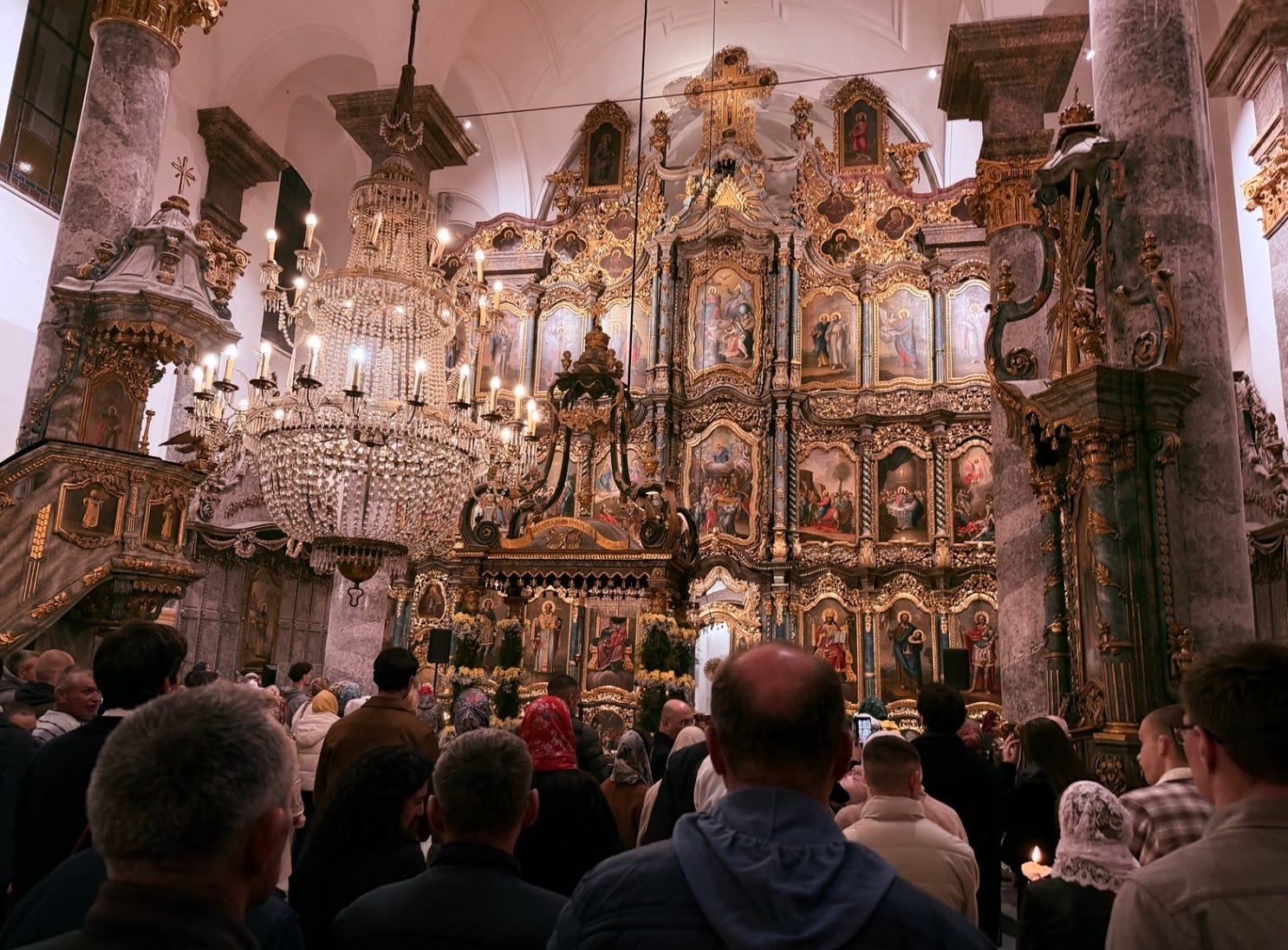
That’s the scene from inside the Orthodox cathedral in Budapest last night, around 2 am. Christ has risen! Truly he has risen!
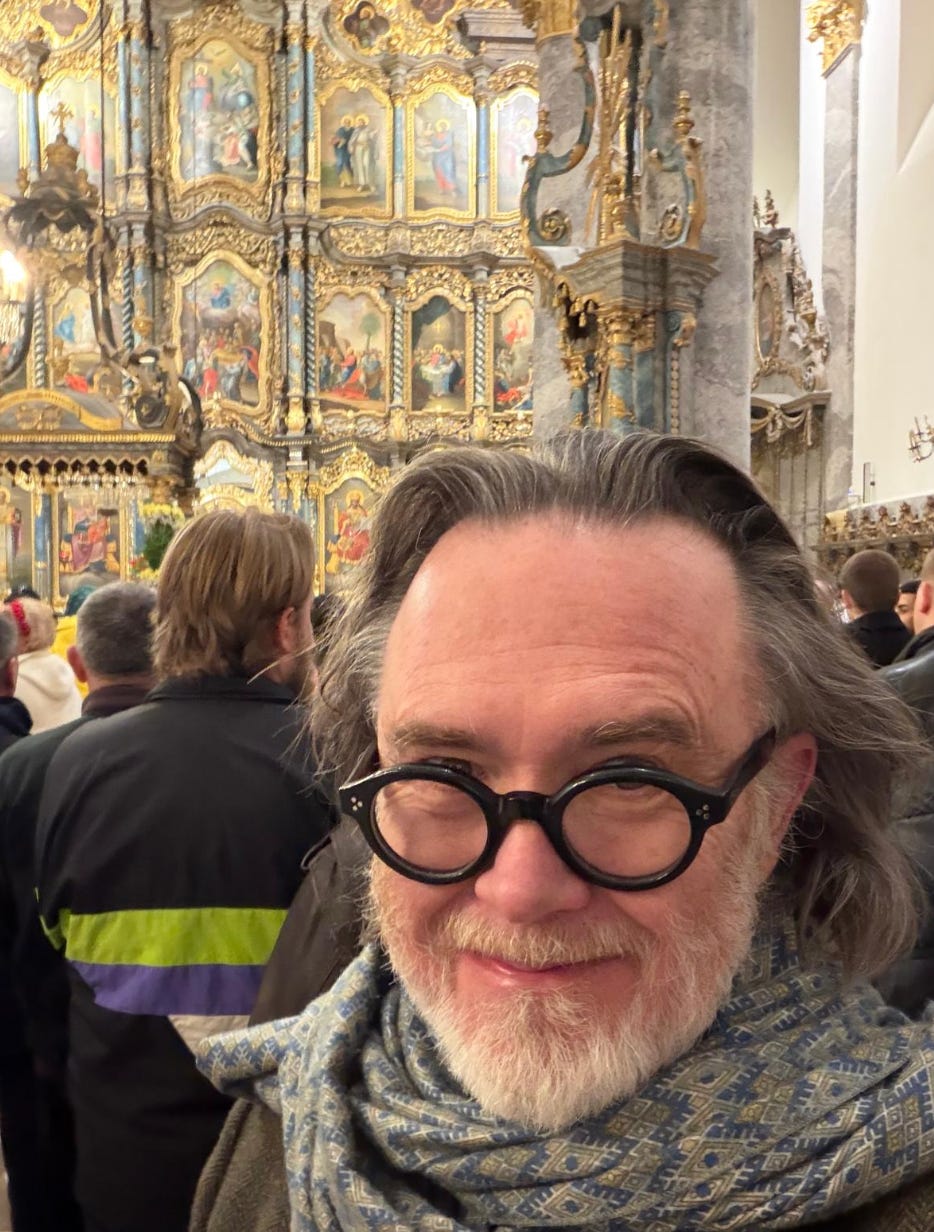
Here is Self after we all just came in off the prayers on the street, in front of the cathedral, and the priests were organizing to start the liturgy. This is the face of a man who is flying high from all the shouts of, “Christos voskrese! Voistinu voskrese!”
On the walk to the cathedral just before midnight, I was filled with peace and gratitude to God for all He has done for me. Budapest is a tense place right now, with the election coming today. Things look bad for Viktor Orban. I didn’t pray that he would win, though that is my hope. Rather, I prayed for God’s will for this beautiful country, Hungary, and thanked Him for it, and for its people. I hope they make the right choice today at the voting booth, but whatever happens, nothing will diminish my love for Magyország and its people.
I am strongly considering moving to Vienna after the election, no matter what happens. If Peter Magyar wins, that will likely make my decision for me, as he may well close the Danube Institute, where I’ve worked for the past four years. He shouldn’t; the DI is not really political, and has done a lot of good work to promote Hungary’s interests, but the atmosphere in the air is vengeful, and Magyar would be under a lot of pressure to get rid of anything Orban-related. Whatever will be, will be.
But on the walk, I was thinking of that Ben Sasse interview, which has been on my mind all week, since it appeared. If you haven’t watched it, do your soul a favor:
One of the things Sasse said really stuck with me. In this passage, he is telling Douthat about what he wishes he had done differently in life, and what wishes everybody knew:
There’s so many times when we optimize around things that are not nearly as important as more family thickness. Boy, I wish we lived down the block from my folks.
When my family was suddenly taken from me by this ambush divorce my ex-wife did, I was filled with regret about not spending more time with my kids. I did spend a fair bit of time with them, but it wasn’t enough. I thought about my son Matt, who lives in Vienna. He finishes grad school this spring, and plans to stay on in the city and work. He and his girlfriend are planning to marry sometime in the next couple of years. Maybe they’ll stay there, maybe not. What I know is that right now, I have the chance to see him more often, but only if I live in his city. So I am thinking and praying hard about moving to Vienna soon, even if Orban wins.
I suspect there are a lot of people contemplating life changes in light of Ben Sasse’s incredible testimony.
With that in mind, last night I walked towards the cathedral, my heart was overflowing with gratitude for what the Lord has given me in this city. Before I headed out, I sent Paschal greetings to my friend Grant, back in America. We were together at that same cathedral last Pascha, when he was living in Budapest. It was his first one as an Orthodox Christian. That night is one of my happiest memories of Budapest. Grant sent me last night an image of the icon of St. Olga:
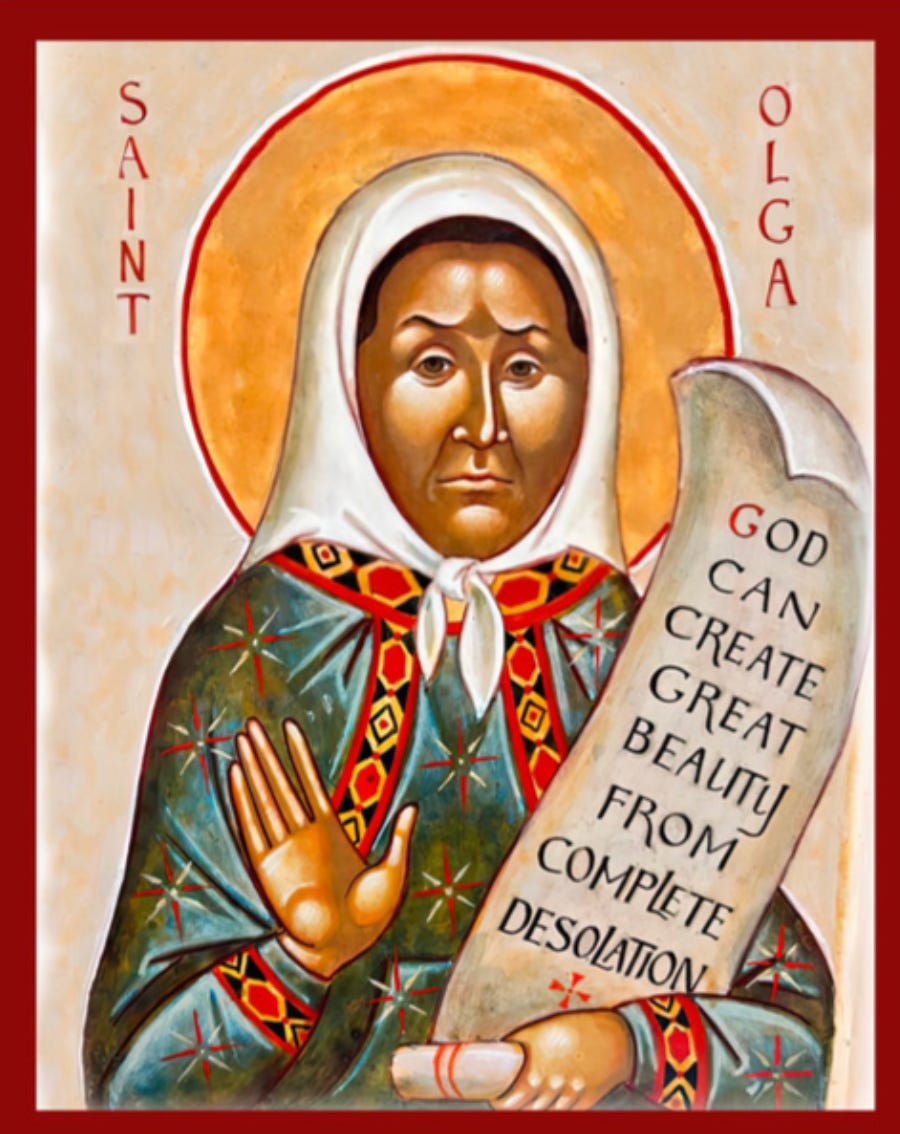
St. Olga Arrsamquq Michael was a Yup’ik woman from Alaska, the wife of a priest. She was a midwife, healer, and wife of a priest. Matushka (“little mother,” what Russian Orthodox call a priest’s wife) Olga was considered a holy woman in life, and after she died in 1979, many people reported miracles through her intercession. The OCA (Orthodox Church in America) writes:
She raised thirteen children of her own in modest means and with deep love. Her home was open; her heart was larger still. She offered hospitality not as a performance, but as a way of life. Whether sewing warm clothes for those in need, baking bread for the altar, or comforting a grieving neighbor, she did all things without self-importance. She was known never to raise her voice, and to teach—like many Yup’ik elders—not with scolding but by example. Those who came into her presence often found themselves stilled, as if by a quiet flame.
Her life bore resemblance to the holy women of the Scriptures. Like Tabitha (Dorcas) in the Acts of the Apostles, she was “full of good works and almsdeeds which she did,” and like the Most Pure Virgin Mother of God, she treasured the mysteries of life and of God in her heart. She clothed the naked, fed the hungry, and helped bring new life into the world. As a midwife, she accompanied women through the dangers and blessings of childbirth; as a counselor, she listened to those suffering in silence, especially women who had suffered abuse. Her presence was maternal, unjudging, and deeply healing.
That link to the OCA page for her talks about miracles associated with her, after her death. For example:
Another woman, a survivor of childhood abuse, saw Matushka Olga in a dream—not as a distant figure, but as a mother and midwife who labored with her soul. In the dream, Saint Olga embraced her, anointed her, and gently removed the pain that had festered for decades. The woman awoke healed of her spiritual torment, no longer afraid of love, no longer ashamed.
A survivor of clerical abuse shared a similar vision: Saint Olga appeared silently, offering no condemnation but only pure maternal compassion, restoring the woman’s faith and helping her begin again.
Well, it’s probably too much to claim that I arrived in Budapest to live in late 2022 in a spirit of “complete desolation,” but it’s not far from the truth. Marriage and family had been at the center of my life, and suddenly, it was gone. I have deliberately not discussed details of the breakdown of my marriage, and its aftermath (including why my older son and I left the country), but let’s just say that this move was not one that either Matt or me undertook because we wanted to have a European adventure. We were both shattered, and needed healing.
I found it in Budapest — or rather, am finding it. I don’t think I will ever be fully healed in this life of the traumatic wound of divorce. Avoiding divorce was the reason I stuck it out for a decade in a marriage that had completely broken down by 2013. But divorce came in the form of an e-mail my wife sent me while I was on a fellowship in Budapest in early 2022, a week before Pascha, and here we are.
Nevertheless, I found a community of dear friends both at the Danube Institute, and around Budapest. I learned a lot about this country and this city, and came to love them. This place is not paradise — no place on this earth is — but it’s a good place, and it gave me the chance to do meaningful work and a space to begin healing. I would have preferred to stay in Baton Rouge, but circumstances made that impossible for both Matt and me (please don’t ask). God provided a way out, to Budapest, and we took it. Matt ended up meeting the Hungarian woman he plans to marry — a good thing that would not have happened if not for the desolation forced upon him by his parents’ divorce. I have spent a fair amount of time brooding, as is my melancholic nature, but I have become far more reconciled to what the rest of my life is probably going to be like, and able to affirm the goodness of the Lord despite it all.
Budapest has taught me to cherish beauty more than I did before. It has also taught me the value of preserving a nation and its way of life. That’s something Viktor Orban made possible, by guarding the borders of this country in ways that cost him personally, and that made him and the nation he leads a pariah in Europe, whose leadership is bound and determined to commit civilizational suicide. In fact, a big reason he stands to lose the vote today is because the opposition finally came up with a candidate, Peter Magyar, who affirms Orban’s (popular with Hungarians) view of nationhood, and the measures the government must undertake to maintain Hungary as a safe home for the people who have lived on this land for over a thousand years.
Indeed, if Orban loses tonight, his tragedy will be in part that the rest of Europe is finally waking up to the fact that he was right all along about migration, and is moving in Orban’s direction. If Magyar wins, all of western Europe’s elites will rejoice, but very soon they will find out that their new man in Budapest will either let them down, or betray many of the people who voted for him. That’s something I’ll write about tomorrow, in the event Orban is ousted.
Anyway, the Magyars have welcomed me and my son, and shown me a lot about their history, and what made them a distinct people. I could tell you about the books I’ve read, the walks I’ve taken, the stories I’ve heard, but for me, the happiest moments I have spent here have been sitting under the leafy trees on the terrace of my neighborhood wine bar (Hungary is not a beer country, but a wine country), drinking fröccs (their name for wine spritzers, the warm-weather drink here), and talking with friends around the table.
One of the best things about European life — not just Hungarian life — is that people here understand that life is really about leisure. Not “leisure” in the usual sense that Americans use the term, but in the sense that Catholic philosopher Josef Pieper means in his great 1948 book Leisure: The Basis of Culture.
For Pieper, leisure is not merely the thing one does when one is not working — hanging out, having fun, and so forth. Rather, leisure is philosophical. It’s a contemplative stance towards the world, a time when one orients oneself in a receptive way towards the world’s goodness, its wonders, and ultimately, to the presence of God. Pieper contrasts this to the modern obsession with working, with acting. Working and acting is part of life, obviously, but we only can know what it means when we sit still and let what we have built, and are building, reveal itself to us quietly. True worship, philosophy, and art emerge from this contemplation. If we live frantically, always trying to stay busy working and getting, we miss the point of life, and our culture will eventually die.
Americans like to make fun of Europe for being “lazy”. I tell you, whenever I return to the US from Europe, I can really see the difference in the philosophical attitudes of the peoples, attitudes of which Americans are scarcely aware. We Americans, in general, do not know how to rest, or at least rest well. We define ourselves by our work. One of the first questions Americans ask each other when strangers meet is, “What do you do for a living?” That’s not the case in Europe. Our American stance — and I was guilty of this too — finds leisure unnatural. Or, it construes it as a thing captured in the phrase “work hard, play hard.” Playing hard is not leisure in the sense that Pieper means it. His view is more like the way pious Jews observe the Sabbath: as a time of meaningful rest. It is the Sabbath that makes the rest of the week meaningful. Lo, here’s what Ben Sasse says he has learned about the Sabbath as he moves towards the grave:
No. 1, honor the Sabbath and keep it holy. Man, I wish I’d treated the Lord’s Day differently over the course of my life. I’ve always known it, believed in it and thought: Maybe next week we’ll get better.
We’ve been at Sunday worship every morning forever, but man, am I tempted by 12:45 or 1:30 in the afternoon to get back to work or, to an addictive level, work about the N.F.L.
Boy, I would treat Sabbaths differently — and especially digital intrusions into the Sabbath.
Facing his death, Sasse has had the meaning of leisure, in the Josef Pieper sense, revealed to him. I wish it hadn’t taken the worst suffering to teach him that lesson. I wish it hadn’t taken divorce and exile for me to learn it. But it did, and I am trying now to make up for all those years in which my work was too much a priority. I cannot recover the lost years, but maybe I can make the years the Lord has left for me more meaningful.
With Ben Sasse, whose loss has been and soon will be far, far greater than my own, I can say to you who are not facing death, or who have not had thrust upon you the loss that I have had: remember the Sabbath and keep it holy. Not only literally, but as an approach to life. How I wish I had made good on those promises to take my son Lucas fishing, as I kept promising to do, but somehow never got around to doing, because there was always a deadline to meet. Shame on me. As Kierkegaard said, the trouble with life is that it must be lived forward, but can only be understood backwards. Well, at the age of 59, I’m telling you that leisure is indeed the basis of culture. Spend more time with your kids, your family, your friends, and most of all, with your God, who gives you all these blessings.
It is true that I have been more solitary in Budapest as I should have been. What can I say? Men, by nature, tend to retreat to a cave when wounded. Now that it appears that my years in Budapest are drawing to a close — not certain, but likely — I regret not leaving my fourth-floor apartment man-cave more often. When I was married, one of my favorite things to do was to have people over for dinner, and cook for them. Maybe I’ve done that only once in the last four years. I just couldn’t find the inner strength to do it. Too sad, if I’m honest. But now, I know that whether I stay here or move to Vienna, that has to change. My relatively eremitic life has been perhaps an understandable reaction to the shock of divorce and loss, but I know, deep down, that I can’t keep living this way. I am called to repent.
People are often astonished by my output of writing, but it has, for me, been a form of escape. I think I have done good work with my writing, and it has sustained me through difficult times. Still, you know the saying, “Nobody lies on their deathbed wishing they had spent more time at the office”? In my case, I will not lie on my deathbed glad that I spent so much time with my laptop, writing. Don’t get me wrong, I love doing it, and it’s what defines me, to a great extent. But the passage of time and the testimony of brave Ben Sasse have taught me that I need to change, somehow.
Anyway, I approached the crowd outside the cathedral last night with a soul at peace and a heart full of gratitude.
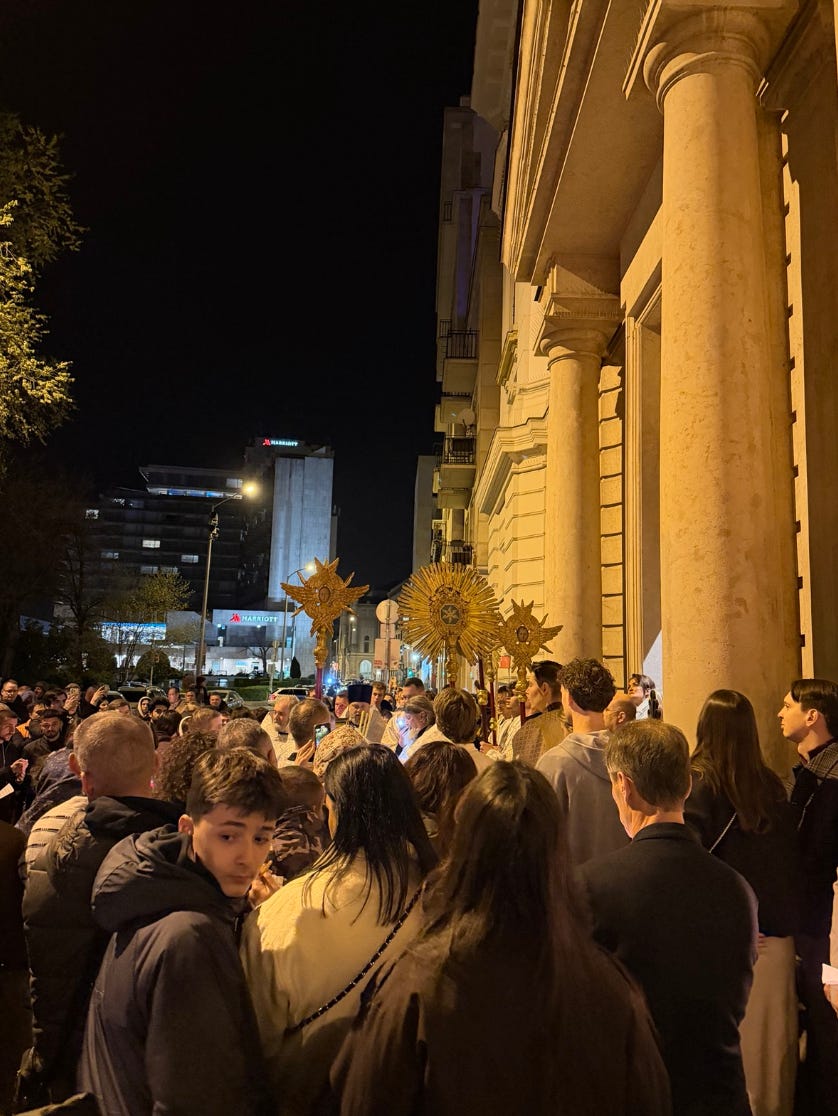
I prayed for God’s will for Hungary, and for His blessings on this country and its people. I also prayed the same for my country, America, which is so troubled. I did so, though, knowing that, in the words we Orthodox sing over and over from this night through the entire Paschal season: “Christ is risen from the dead, trampling down death by death, and upon those in the tombs bestowing life.”
I thought: God loves us so much that He suffered and died for us, so that we can know everlasting life — a life that begins not after we die, but right now. Look and listen to Ben Sasse, who is in deep physical agony, and suffers too from knowing that though he is only in his fifties, he will leave behind a wife and children. And yet, what you see on that video is a man whose soul is at peace — joy-filled, even. Contrast that to another recent Douthat interview, with the Biblical scholar Bart Ehrman, who lost his faith because he could not make sense of suffering. Ehrman is an intellectual, who dilates in a scholarly way about how he could not reconcile the idea of an all-powerful God with the existence of suffering.
I get it. But along comes Ben Sasse, who is suffering an excruciating death, to announce the good news: Christ is risen! And that, for Sasse, makes all the difference. He goes to his death praising God, with a heart filled with love. Truly, as St. Paul said, the Gospel is foolishness to the Gentiles. Ben Sasse, a former university president, is no dummy. But he has accepted the higher wisdom. In death, he chooses life. He radiates the joy of the Lord. That’s who I want to be. That’s who anybody who doesn’t hate life wants to be.
I have become a little bit more of that man from my four years in Budapest. I would not have chosen to spend the latter years of my middle age living on the banks of the Danube in a small Central European country, but God opened that door, and I walked through it. And I am a better man for it, only because in my imperfect, wounded way, I was able to accept the unbought grace of life as it presented itself in a foreign land, far from home.
Tonight I will go to an election night party with Orban supporters. I was at this same party in 2022, which turned into a big celebration (they figured Fidesz would win, but not by the margins that they did). This year, it stands a pretty good chance of being a wake. I hope not, but even if so, God is with us, and will not abandon us. All things must pass, but He endures forever. Glory to Jesus Christ, the risen Savior! And thank you, Jesus, for this city, this country, and its people, who were a gift to me when I had had everything I loved taken from me in a single dread morning.
I’ll leave you with this. The divorce e-mail came in 2022 on the day before Palm Sunday. I left the next day for a planned trip to Jerusalem, to spend Orthodox Holy Week. My heart was entirely broken; I moved through the streets of the Old City like a zombie, reciting the prayer over and over in my heart, “Lord Jesus Christ, have mercy on me.” And He did. Here’s a photo of me a Scandinavian woman in our group took at the Holy Fire miracle in the Church of the Holy Sepulcher on Holy Saturday (I wrote about it here). Is this the face of a man who has lost everything? It is — but it is also the face of a man who knows that Christ is risen, and will not leave his side, no matter what.
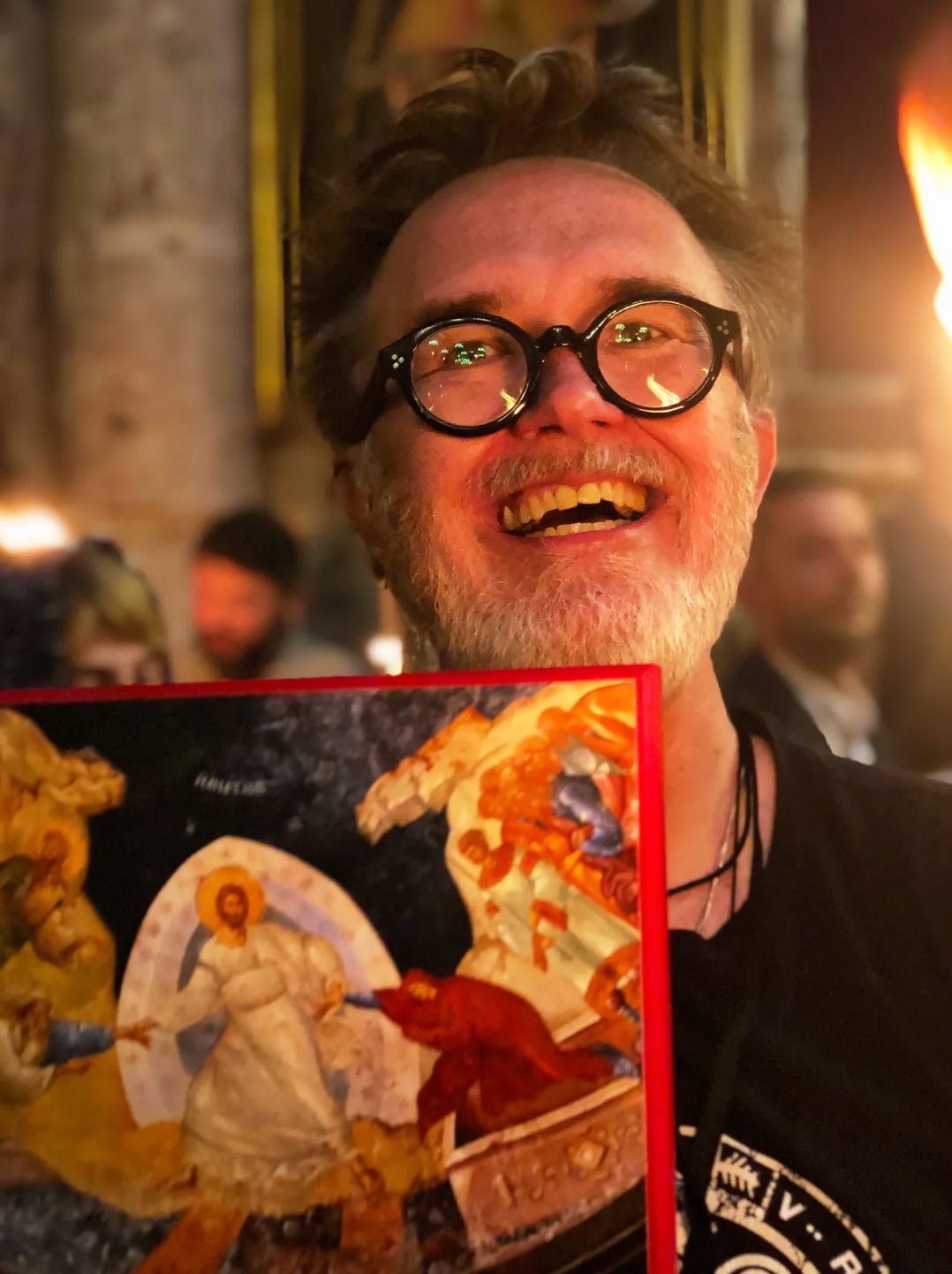
You know, I write about doom-and-gloom a lot, but I can bear it calmly because Christ is risen, and I know that no matter what we suffer now, and might have to suffer in the future, all things have ultimate meaning, because God exists, and his Son suffered, died, and rose from the dead. This is the hope of all who unite themselves to Him. Last night, I was also overwhelmed with gratitude that I came to know Him in a much deeper sense through the Orthodox way of living the faith. That too was a gift the Lord gave me amid what, until my divorce, had been the greatest disaster of my life.
St. Olga, the humble Yup’ik woman, was right: God can create great beauty out of complete desolation. He really does make all things new, if you will let him.
A blessed Pascha to you all! I think I’m going to get dressed, and go sit under the trees at the wine bar, and re-read some Josef Pieper. Leisurely, of course…
One of the things I liked about my old US parish is that we were encouraged as a congregation to say "Christ is risen, Truly He is risen" in as many languages as possible. I always chimed in with French: "Christ est ressuscité! En vérité, il est ressuscité!"
I've always thought the traditional Eastern salutation of Christ Is Risen! with its response Truly He Is Risen! to be superior to our bland Happy Easter. But to cover all bases, I send along both greetings to you, Rod.
You know, I was doing some research on the Shroud of Turin not long ago, and it's a mindboggling artifact. As a scientist who investigated the mysterious relic said, it would take a bigger miracle for the cloth to be fake than genuine.
Indeed, all evidence points to only one explanation: a colossal burst of energy, enough to incinerate the city of Jerusalem but confined to an impossibly tiny area, imprinted the negative flash image of a crucified man not only corresponding in every detail to the biblical account of the passion of Christ but also medically accurate -- pierce wounds in the wrists and so forth -- in ways that no medieval forger could possibly have understood. Beyond that, the idea that a photographically negative image would have been precisely generated by an artist centuries before the invention of photography is preposterous on its face.
Anyway, it is truly providential that in an age of defection, doubt, and despair, there should emerge incredible physical evidence testifying to the miraculous truth at the center of our faith. "He is not here. He goes before you into Galilee." And far beyond...