Same Planet, Different Worlds
And: 'Slopaganda' In Our Time; Weimar Is Not Fated; Kale Zelden & The Odyssey


Saw this yesterday on X, attributed to Musa al-Gharbi, a black left-wing professor at Columbia University, about what he noticed when he first moved to Manhattan:
One of the first things that stood out to me is that there’s a racialized caste system here that everyone takes for granted. You have disposable servants who will clean your house, watch your kids, walk your dogs, deliver food to you... mostly minorities and immigrants and disproportionately women... And this is basically taken for granted in New York, that this is the way society operates.
And yet... this is not how things are in many other parts of the country. Most other places, the person buying a pair of shoes and the person selling them are likely to be the same race — white — and the gaps between the buyer and the seller are likely to be much smaller. Even the most sexist or bigoted rich white person in many other contexts wouldn’t be able to exploit women and minorities the same way as the typical liberal professional in a city like Seattle or New York; the infrastructure simply isn’t there. It’s these progressive bastions associated with the knowledge economy that have these well-oiled machines for casually exploiting the vulnerable, desperate and disadvantaged. And it’s largely Democratic-voting professionals who take advantage of them.
A few months after I arrived at Columbia, Trump won. I expected this to happen, but for most people, that was not the expectation. So here at Columbia, the day after Trump won, a lot of the students claimed to be so traumatized that they couldn’t do tests or homework. They needed time off. Now there are two things striking about that to me.
First, these are students at an Ivy League school, overwhelmingly people from wealthy backgrounds — and even if they don’t come from wealth, they’re likely to be well-positioned... [but these] students seemed to view themselves as somehow uniquely vulnerable to Trump and his regime, as being especially threatened or victimized. And so they demanded all of these accommodations for themselves.
Meanwhile, there was this whole other constellation of people [mostly minorities and immigrants] around them who seemed to be literally invisible to them.
The people doing all the work on the campus... these ignored laborers — the people with the most at stake in this election — [were not] saying they needed time off because they were too traumatized. They showed up to work the next day and did their jobs. They weren’t making a scene, sobbing as they scrubbed rich kids’ mess out of the toilets. The juxtaposition was sobering... When I left campus, walking around the Upper West Side, or other affluent parts of Manhattan, similar scenes were playing out. Nor was New York City unique in this regard. Other knowledge economy hubs had similar scenes playing out. And the same drama that was playing out in Columbia was unfolding at colleges and universities across the country.
This is precisely what I found so troubling, so difficult to shake off: It wasn’t about my own school. It was about this broader disjuncture between knowledge-economy elites, their narratives about the world, and the realities on the ground.
Interesting. Older readers of my work will remember something I posted six or seven years ago on my old blog. I was in Boston for something, and met with a European friend who had spent the past year at Harvard on a fellowship program. He said the thing that hit him hardest about his year at America’s top university was how psychologically and emotionally fragile the students are — that, and how the professors catered to them by changing their teaching to avoid triggering them.
My friend said all, or nearly all, of the Europeans on the fellowship were from the political left, but even they were shocked by this. And, added my friend, it was also striking that despite their fragility, the American elite students had no doubt that they deserved to rule. He told me this worried him about the future of his country, dependent as it is on the United States.
As I’m proceeding with work on this Weimar America book, some things are emerging more clearly in my research — things that highlight starkly the differences between 1920s Germany and 2020s America, but that also, weirdly, reveal their similarities.
As I written here many times, Hannah Arendt said that social atomization was by far the most important factor behind the rise of totalitarianism in both Germany and Russia. As I’m focusing entirely on Germany for this book, I’ve been learning exactly what that meant in 1920s Germany. World War I had smashed so many communal bonds, institutions, and things that held people together. There was this quote from Klaus Mann, the 17-year-old son of the novelist Thomas Mann, talking about his generation in the immediate aftermath of the war: “With everything around us crumbling and shaking, what were we supposed to cling to, what laws were we supposed to follow? We were introduced early on to apocalyptic moods and became quite experienced in dissipation and excess.”
If you make a direct comparison between the historical events that led to that state of affairs in Germany, and conclude that because the US has not had anything like a horrible war, or the 1923 hyperinflation, which wiped out the middle class, then any comparison of our country today to Weimar Germany is fatally flawed — well, you will blind yourself to a more subtle, but absolutely key, point.
We in America have arrived at a state of widespread social atomization without having had our world smashed by war and economic catastrophe. We have arrived at a very similar place in a slower, far more comfortable way: through the accumulation of wealth, and the dissolution of social bonds through social liberalization and individualism. This is the Bowling Alone phenomenon that Robert Putnam first observed. This is Christopher Lasch’s Culture of Narcissism, which, as one of you readers pointed out the other day, caused Lasch to conclude in the 1990s, when he published the book, that we Americans were losing the habits of mind and heart necessary for democracy to work.
What Musa al-Gharbi saw at Columbia, and what my European friend observed at Harvard, is part of this dynamic. We just don’t see each other anymore. Same thing is happening in Britain: the ruling class, both Tory and Labour, have long since disconnected themselves from the broader masses of people in the UK. Perhaps without realizing what they were doing, they governed with the interests of themselves, and their own cultural class, in mind, ignoring everybody else. Last year I was at a gathering in London that was, in my estimation, made up of standard Tories, and I picked up that they simply had no real idea what life was like for people outside their bubble. They considered white people on the Right — people superficially like them — who had come to more radical conclusions about the condition of the country, to be racist, alarmist, or otherwise Not Worth Taking Seriously.
Honestly, and in all charity, I don’t think they realized what they had done, and were doing. These days, we all operate under a massive blindness mechanism that was not present in 1920s Germany: the Internet, of which social media is a part. It is not so much that it’s easy to be siloed and cut off from the experiences of people like ourselves, as it is that, thanks to the nature of this technology that pervades our lives, it’s almost impossible to avoid it.
You might think: well, that’s other people, but not me. Careful there. I don’t see how any of us can avoid this cognitive blindness, which is caused by tech-driven social atomization, combined with psychological and political dispositions common to our social caste or group.
You might not see this, because I just posted it on yesterday’s comments section, and most people won’t read it a day later, but it’s worth repeating here, in this context. A decade ago, I helped the black actor Wendell Pierce write Wind In The Reeds, his memoir about how growing up in New Orleans shaped his worldview. In my comment, I misattributed this story (from the manuscript, which I just dug up) to Wendell’s Uncle Lloyd, the sister of “Tee,” Wendell’s mother. Still, here’s the story; “College Point” is the name of the little black community in rural St. James Parish, where Wendell’s mother’s family came from:
When Tee was a child, a black family in College Point somehow scraped the money together to buy a new car. They were so proud of that automobile and showed it off to all their neighbors. It was like a gift to the community, because they could give people who walked everywhere a ride.
“I remember the night that the night riders came and burned that car,” Tee told me. “They said, ‘You niggers, don’t you think about getting no cars. Let this be a lesson to you.’”
That infuriated my mother. What did that black family having a car have to do with those Klansmen? How did it hurt them? And the thing is, Tee told me, all the black folk knew exactly who the night riders were. The men may have worn white robes and hoods, but the people they terrorized knew them all. It didn’t matter. They were the law. They burned the black man’s car as a message to the entire black community: Don’t think you can ever have nice things or get ahead in this life. You are made to be poor and beneath us, and the sooner you get that straight, the better off you’ll be.
Right there, as a little girl, Tee resolved never to let anyone deny her anything—not the right to go anywhere she wanted to go, learn anything she wanted to learn, or be anything she wanted to be. But she also learned that you had to be smart about it, and she passed that childhood lesson on to my brothers and me.
I had thought that Uncle Lloyd told me that story, but I was wrong. I interviewed Uncle Lloyd, the last surviving member of his generation, at his house not too far from College Point. Though he was old, his mind was very sharp. He told me all kinds of stories about growing up black in that time and place. There were lots of stories like the one I just quoted. At one point, I blurted out, “Why are you not angry all the time?!”
And then it hit me: I had learned something important. Black people and white people in south Louisiana, even to this day, live in different worlds, even as they share the same towns. This history I was learning from Wendell, and his uncle, was simply not part of my reality. Often I find myself puzzled and frustrated by why black folks do what they do, and think what they think. What I was learning that day at Uncle Lloyd’s table was history and context. This did not justify everything black people believed about the world, and how they reacted to it. But, I was learning, you can’t separate the way they think and act today from the cultural memories they carry in their minds.
One of Lloyd’s brothers, by then deceased, had been angry all the time, and it led him to make foolish decisions. This is all part of life, you know. Lloyd had a more even temperament, and followed the direction of his parents, who told their kids to stay steady, get your education, and keep working hard. You will eventually overcome.
I cited the burning car story in my comment on the thread to point out why it is so vital for us to learn history, to try to understand why others — even our enemies (the Iranians, in this case) — see the world the way they do. It doesn’t make them right, but if we are going to deal with them wisely, even in war, we need to work to understand how and why history and experience had formed their worldview in such a way.
Rich white liberals, as Musa al-Gharbi observes, live and think completely cut off from wider experience, even of the peoples (racial minorities) with whom they claim to sympathize. We know all too well how white liberals typically see the white working class as the only people they permit themselves to hate (this is certainly true in the UK too). But this phenomenon affects all of us. I’ve spent the last four years in conversations with journalists and others from the US, UK, and western Europe, trying to explain what historical factors cause the Hungarian people today to see the world in the way that they do. Journalists and others coming from outside are so blinded by their own mental frameworks and prejudices. They resist seeing it — sometimes, I can see this manifest physically, in their restlessness and anxiety.
I keep telling them: I’m not trying to convince you that the Hungarians are right. I’m trying to help you understand why they think the way they do. Very few people outside of this country know a thing about Hungarian history, aside, maybe, from the failed 1956 uprising against the Soviets. In fact, the most important political fact to know about this country is the traumatic effect the 1919 Treaty of Trianon had on the Hungarian people. This was the treaty that punished Hungary for its part in World War I (as part of the Austro-Hungarian Empire) by carving away two-thirds of Greater Hungary, to create new nations. The cultural memory of this is very much alive among the people here, even left-wing people. It was a moment in history in which they all learned how helpless they were, as a small nation, before the geopolitical knives of stronger powers.
They learned it again during World War II, when it was all but impossible for them to resist Hitler, in next-door Germany, and then from 45 years of Soviet occupation. So, I tell my foreign interlocutors, when you see Viktor Orban behaving like what you consider to be a horse’s ass in insisting on Hungarian sovereignty, and not bowing obediently to whatever the European Union governing class believes is just and correct, the mentality forged by their miserable 20th century experience has a hell of a lot to do with it. This mentality has deeper roots than Trianon, but Trianon is the most neuralgic point. But we foreigners, we don’t know history, and we don’t care.
Immersing myself in the history of 1920s Germany has helped me to understand that had I been a German during the Great Depression, it would have been very hard to resist the siren song of the Nazis. The suffering, material and psychological, was beyond all telling. There’s a scene in one episode of Babylon Berlin, the excellent crime drama set in late Weimar Berlin, when one of the main characters finds herself in a poor part of the city. There she sees standing against the wall a heavily pregnant prostitute. It’s deeply shocking, but I tell you, women like that really existed. There were perverts who paid top dollar for them, and during the Great Depression, so many German women were so desperately hungry that they turned tricks, even while pregnant, to feed themselves and their families.
Just imagine what you, yourself, might be capable of believing for the sake of deliverance from conditions that led to that kind of decadence. And believe me, the pregnant prostitute was just a tiny part of it. Child prostitution was a big thing too. The Germans were so desperate, so poor. None of this, of course, justifies Hitler, but if you don’t try hard to understand why Hitler appealed to the masses — that is, what historical, material, and psychological circumstances made him seem like a solution — then you will have missed something vitally important, not just about Nazi Germany, but about human nature.
What I’m trying to do with this new book is not to say “We’re going to get an American Hitler!”, but rather to illuminate how our very modern, very American circumstances could easily produce a totalitarian “solution,” tailor-made to our times.
I bring this up here to illuminate the deeper meaning of what Musa al-Gharbi saw at Columbia. It is not possible for human beings in any large society to know well what people outside of their own social class, geographical location, and so forth, are thinking and feeling. But technology has made that harder than ever. It’s impossible to overcome fully, but we have to push back against it as much as we can, if only so we can live in reality, or as close as we can get to it. Remember Iain McGilchrist’s insight about psychology: You create your own reality by what you chose to pay attention to.
All of us have to make decisions based on what we believe to be real. But we also must do so with the awareness that we don’t have the full story, and can’t possibly get the full story. One reason I find some of the comments about the Iran war in this Substack’s comments section so frustrating is what I experience as the angry determination by some that the only reason anybody would question this war, or this or that aspect of its conduct by the US, is because of bad-faith reasons. “Trump Derangement Syndrome,” and the like. I remember all too well how this mentality was so triumphant during the walk-up to the Iraq war. I participated in it too. And it led to very bad outcomes.
This does not make my judgments about the Iran war correct. It could be that I’m placing too much stock in the Iraq lessons. I’m open to being corrected. But I am very conscious of how emotions and idealism can blind us. In fact, it’s a big reason why I love studying history: to get outside my head, and to see the world through the eyes of others. In the case of the Iranians, I loathe the Islamist regime, and devoutly wish they would be overthrown, and consigned to history’s dustbin. But if we don’t try to understand our enemy, what makes him tick, and why he fights, we actually put ourselves at a disadvantage — one that could cost us.
Back in 2002, when people like Pat Buchanan were warning that the Iraqis were a people driven by religion and tribalism, and were not prepared for parliamentary democracy, people like David Frum (it might have been him specifically, but if not him, then someone in his circle) criticized Buchanan and his sort for being bigoted towards Arab Muslims. (“What, you think Arab Muslims aren’t capable of democracy? You must be some kind of racist.”) America learned the hard way that Buchanan was right. It had nothing to do with racism. It had to do with an understand that liberal democracy is not the natural state of man, and that it emerges, and is sustained, by habits of mind and culture, formed by history.
Some of you will remember the story I’ve told here about dinner in Moscow in 2019, at the end of my days in the city. I had been speaking in previous days with people about the Soviet repression and its horrors. At the dinner table with an ordinary Russian Orthodox family, I said, “I cannot imagine why anybody ever believed what the Bolsheviks promised.”
The father then launched into a lesson of the 400 years of Russian history prior to the 1917 Revolution. He talked of the unspeakable poverty and oppression Russians suffered under the semi-feudal system presided over by Tsar and Church. He was in no way sympathetic to the Bolsheviks; indeed, he was a faithful Orthodox Christian, His point was simply to get me to understand that the appeal of Bolshevism came from somewhere real. That it wasn’t simply a matter of Russian people being idiots.
I was chastened. I learned something true in that moment about history and human nature, and also about the reflexive blindness native so many of us Americans, a profoundly ahistorical people, more focused on the future than the past. Many of us Americans laughed a couple of years ago, when Tucker Carlson interviewed Putin, and Putin launched into a long discourse about history. I didn’t laugh, because I live now in a part of the world where people in general are far more conscious of history, and how the past isn’t really past.
To be fair to my critics: it is entirely possible to be a prisoner of historical experience. That too is one lesson of living among these history-obsessed people of Central and Eastern Europe. I think of how for the late Jesse Jackson, American history was forever frozen on the Edmund Pettis Bridge in Selma, Alabama. That experience was so searing that he couldn’t see past it. For him, American life was Forever Selma, and this led him to make serious political misjudgments, because he couldn’t see how America had changed.
Similarly, it is at least possible that I am too stuck in the painful Iraq War history to see this Iran situation clearly. I’m grateful to the reader who sent me this WSJ column by Bill Galston (I’ve unlocked it for you), a liberal, who argues that both Iran hawks and Iran doves got Iran wrong. Galston says the hawks mistakenly thought Iran would be easier to deal with than it has proven to be, while the doves wrongly concluded that Iran wasn’t as big a threat as it actually is. I’m definitely in the dove camp in this regard. As I wrote here last weekend, realizing that the Iranians have far more long-range missile capacity than we had thought before, and that these crazy mofos seem willing to blow up even the Dome of the Rock in Jerusalem, one of the most sacred Islamic sites in the world, for the sake of bring about the Shia apocalypse, shifted my thinking somewhat.
I guess, to wind down, that this early 2003 all-time monument to ideological blindness stands tall in my mind as a guide to How Now To Think:
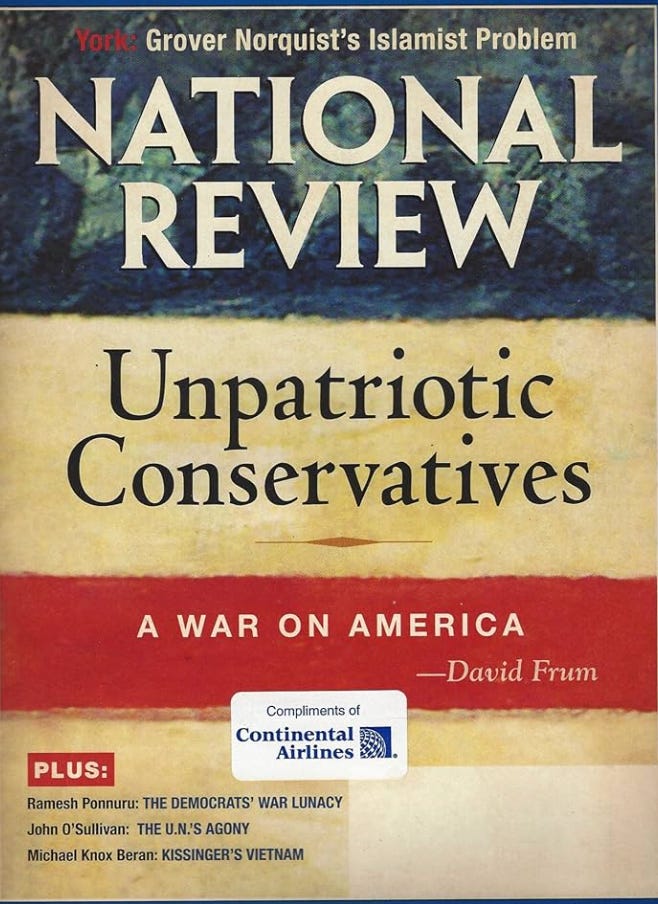
The “unpatriotic conservatives” in Frum’s piece were Buchanan, Novak, and others on the Right who dared to question Bush’s war. I accept the invitation of you war hawks among us who keep telling me to think harder, in the face of my dovish instincts. You’re right — I do need to do that. To that end, I appreciated the reader who sent me this link to Fran Maier’s new piece in First Things about the nature of this war. For me, this war is not about whether or not the Iranian regime is hostile and dangerous to US interests. The question is first about whether or not that danger justifies this war, not as a moral matter but as a matter of prudential judgment, and secondarily how this war is being prosecuted.
And yet, I invite this newsletter’s readership who are super-hawkish about the war to think hard about how you might be this year’s David Frum, who attempted to shut down debate and discussion on the Right over the Iraq War by anathematizing dissenting conservatives as America-haters. Never be this year’s David Frum.
