Sunday In Budapest
Musings On Blessings, Joan Of Arc & Deliverance, The Land Of Israel, & A New Convert

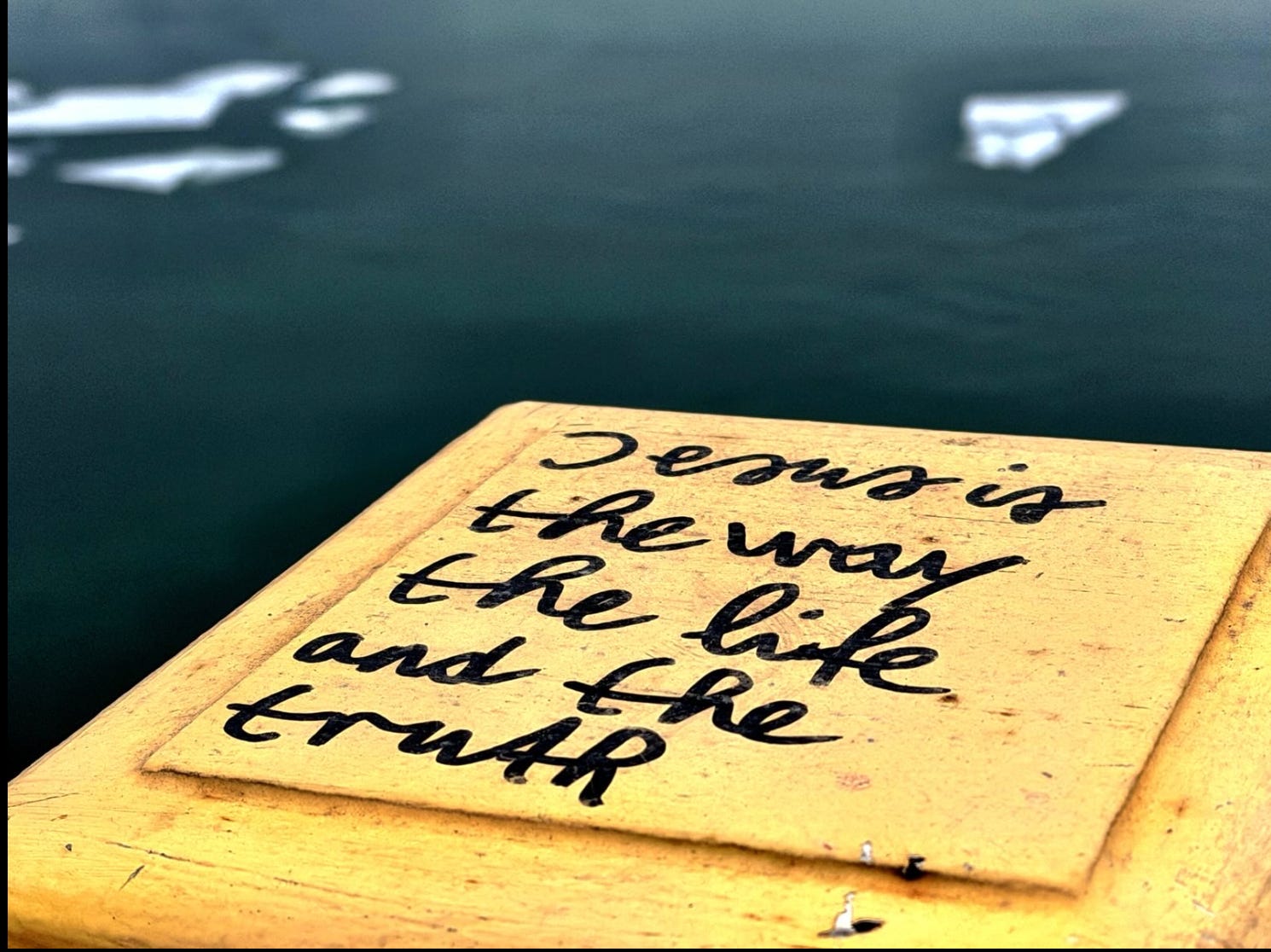
I know it’s Sunday, but I also know that tomorrow morning’s newsletter will be preoccupied with the horrors of Minneapolis. I wanted to share some spiritual things with you today, before they’re drowned out by the coming week’s cacaphony.
Something incredibly good happened to me on Saturday, a blessing I’ve spent the last four years praying for. For the sake of family privacy, I won’t say what happened, only that it left me on my couch afterward praying tears of joy, and thanking God. I know too that many of you have been praying for me for some time. Well, those prayers were answered, at least in part, and in a way that suggests a good way forward. Going to the liturgy this morning was different than it has been in ages. I had so much weight lifted from my shoulders.
I offered to Our Lord in thanksgiving the Akathist Glory To God For All Things, which I last prayed one year ago, on Mount Athos. It’s a stunning prayer of praise and celebration of God’s manifest goodness. It was composed by a Russian Orthodox priest, Father Gregory Petrov, when he was imprisoned in the Soviet gulag, and found among his possessions after he died there. Here is how it starts:
Kontakion 1
Everlasting King, Thy will for our salvation is full of power. Thy right arm controls the whole course of human life. We give Thee thanks for all Thy mercies, seen and unseen. For eternal life, for the heavenly joys of the Kingdom which is to be. Grant mercy to us who sing Thy praise, both now and in the time to come. Glory to Thee, O God, from age to age.
Ikos 1
I was born a weak, defenseless child, but Thine angel spread his wings over my cradle to defend me. From birth until now Thy love has illumined my path, and has wondrously guided me towards the light of eternity; from birth until now the generous gifts of Thy providence have been marvelously showered upon me. I give Thee thanks, with all who have come to know Thee, who call upon Thy name.
Glory to Thee for calling me into being
Glory to Thee, showing me the beauty of the universe
Glory to Thee, spreading out before me heaven and earth
Like the pages in a book of eternal wisdom
Glory to Thee for Thine eternity in this fleeting world
Glory to Thee for Thy mercies, seen and unseen
Glory to Thee through every sigh of my sorrow
Glory to Thee for every step of my life’s journey
For every moment of glory
Glory to Thee, O God, from age to age
I got to thinking during the liturgy how much of a trial these past few post-divorce years have been, and how unfaithful I have been, in terms of despairing. But God is merciful. The time of trial is far from over, but I can see the dawn coming after this weekend. Don’t lost hope!
By the way, I’m going to Oslo this coming weekend to speak to a Christian conference about Living In Wonder. I’m going to ask an Orthodox priest who will be present to read aloud before my talk a small part of this akathist, to prepare my Protestant audience for what I mean when I talk about living in wonder, in enchantment. This, from the akathist, is the kind of thing I mean:
Kontakion 3
It is the Holy Spirit who makes us find joy in each flower, the exquisite scent, the delicate colour, the beauty of the Most High in the tiniest of things. Glory and honour to the Spirit, the Giver of Life, who covers the fields with their carpet of flowers, crowns the harvest with gold, and gives to us the joy of gazing at it with our eyes. O be joyful and sing to Him: Alleluia!
Ikos 3
How glorious art Thou in the springtime, when every creature awakes to new life and joyfully sings Thy praises with a thousand tongues. Thou art the Source of Life, the Destroyer of Death. By the light of the moon, nightingales sing, and the valleys and hills lie like wedding garments, white as snow. All the earth is Thy promised bride awaiting her spotless husband. If the grass of the field is like this, how gloriously shall we be transfigured in the Second Coming after the Resurrection! How splendid our bodies, how spotless our souls!
Glory to Thee, bringing from the depth of the earth an endless variety of colours, tastes and scents
Glory to Thee for the warmth and tenderness of the world of nature
Glory to Thee for the numberless creatures around us
Glory to Thee for the depths of Thy wisdom, the whole world a living sign of it
Glory to Thee; on my knees, I kiss the traces of Thine unseen hand
Glory to Thee, enlightening us with the clearness of eternal life
Glory to Thee for the hope of the unutterable, imperishable beauty of immortality
Glory to Thee, O God, from age to age
Tarot In The French Quarter
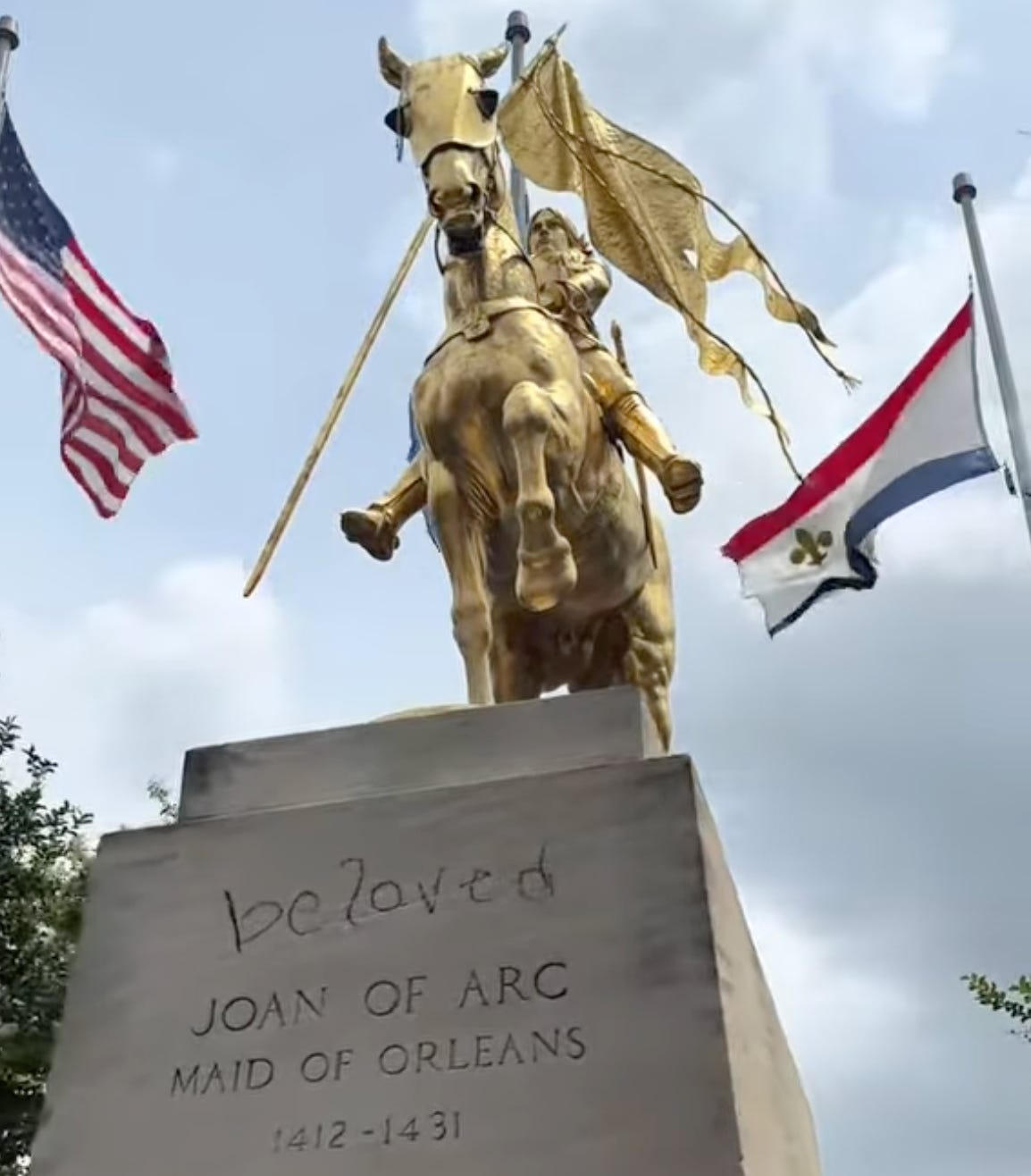
Got caught up today with the latest episodes of The Exorcist Files, the terrific pastoral podcast from Father Carlos Martins, a Catholic exorcist. Part One is here; Part Two is here. It’s one of the best ones ever. It tells the story of “Geraldine,” a young woman who went down to New Orleans with her friends during Mardi Gras. On a lark, Geraldine got a tarot reading from a man set up with a card table on the street in the French Quarter.
Soon after, she and her two friends — all of them Catholic — went into nearby St. Louis cathedral. Geraldine began to experience weird reactions — blasphemous things against Jesus Christ, and, interestingly, St. Joan of Arc, whose statue is outside on Jackson Square.
Geraldine and her friends went back home, but she sank into possession. Eventually she was delivered through the power of God via exorcism. It’s a terrifying story, but a hopeful one.
What I love about the way Father Martins tells these stories is that he wants people to understand the scary reality of this stuff, but he also wants people to understand both that there is rescue in Christ, and second, how they should be living as Christians to keep the door closed to demonic attack. Above all, The Exorcist Files is pastoral.
Father Martins uses this case to strongly warn listeners against tarot cards or any form of divination, which the Bible forbids. We don’t know why some people can mess with this stuff and suffer no apparent spiritual ill effects, and others become demonically afflicted, but it happens, and no good can come from it. At the end of this two-part episode, Father Martins speculates that the tarot card reader might not even have understood the malevolent powers he was channeling. But they are real.
What’s interesting too is that Geraldine, like her friends, was and is a believing Catholic. But her faith was not strong enough to keep her from the tarot stunt, nor was it strong enough to keep her from sleeping with her boyfriend. It came out in the exorcism that this particular sin was part of the bondage the demon claimed over her. Father Martins says we can’t tell ourselves that things like this are not really serious; in the spiritual world, they are, and can lead to spiritual disaster.
It brought to mind this quote from Aldous Huxley that a Catholic friend texted to me over the weekend:
From Ends and Means: An Inquiry into the Nature of Ideals:
“I had motives for not wanting the world to have a meaning; and consequently assumed that it had none, and was able without any difficulty to find satisfying reasons for this assumption. The philosopher who finds no meaning in the world is not concerned exclusively with a problem in pure metaphysics. He is also concerned to prove that there is no valid reason why he personally should not do as he wants to do. For myself, as no doubt for most of my friends, the philosophy of meaninglessness was essentially an instrument of liberation from a certain system of morality. We objected to the morality because it interfered with our sexual freedom… There was one admirably simple method of confuting these people and justifying ourselves in our erotic revolt: we would deny that the world had any meaning whatever.”
This was 100 percent me during my college years, as I reckoned with whether or not to become a Christian. I saw in retrospect that almost all of what I thought at the time was genuine intellectual struggle with the concept of Christianity was really about me trying to find some rational way out of having to abandon the “erotic revolt” that I so deeply desired. Even now, as a Christian well into middle age, I struggle with how much sexual purity really matters to God.
I don’t want to give you the false idea that I’m some sort of Yankee tomcat, prowling the streets of Budapest. Rather, it’s the case that we live in a thoroughly eroticized world, one in which even believing Christians like me can be tempted to think that God really doesn’t care as much about impurity as all that. Father Martins’ podcast reminded me that it really does matter, and the spiritual battle for purity in our bodies as well as in our souls is worth fighting.
He has some very powerful words at the end, assessing how the mere belief in God, and in the Catholic faith, did not protect Geraldine from the Enemy:
Geraldine’s case is revealing in what it teaches us about relationship. Geraldine, Kevin, Emily, and Rachel were sincere Christians. They all had a relationship with Christ, but their faith was too shallow and lukewarm to protect them from evil. It didn’t shape their choices enough to keep them from sinning, such as engaging in a harmless tarot reading on Bourbon Street, or [not] preserving the marital act for marriage.
What makes a Christian a Christian is not belief in Christ. If that was all it took, then the Devil, who knows the truth perfectly, would be the greatest Christian. What makes a Christian a Christian is his obedience to Christ.
… Most of you listening will never experience what the Church calls possession. But all of us, without exception, are engaged in the same spiritual warfare, though at a lower temperature. We are daily tempted towards “harmless compromises”: a little curiosity about forbidden things, a little contempt for prayer, a little resentment towards the holy. The Enemy’s strategy is always to make sin look trivial, and repentance look dramatic. In reality, it is the other way around. Sin is what destroys us; repentance is simply coming home.
A little contempt for prayer. How often do I choose not to say morning prayers, because I’m too eager to get online and see what happened overnight? How often do I make short work of evening prayer, because I’m sleepy, and have spent too much time on the Internet, or reading, or whatever? A lot, is the answer. Father Martins reminds us that these seemingly trivial decisions could have very serious consequences for our souls.
That double episode of The Exorcist Files is also pretty great for the role that St. Joan of Arc plays in this contemporary spiritual battle — especially a relic whose authenticity Father Martins doubted, until the demon possessing Geraldine shrieked at it. As Father says in one of these episodes, the saints aren’t simply some sort of friendly “ghosts” for our contemplation, but great victors in the long spiritual war against the Devil, fighting for us from heaven.
Judaism And Supersession
I received a letter from the Rev. Gerald McDermott, a subscriber, a priest in the Reformed Episcopal Church, and a widely-published Christian scholar. He gave me permission to reproduce the letter here, which he sent in my response to my remarks in this space the other day about Christian Zionism. The priest writes:
I am an Anglican theologian who has been to the Holy Land 25 times and have friends there who are Arab Christians, Muslims, Catholics, and Orthodox. I have written and edited four books and many articles on these questions of the Land, Jewish roots, and Zionism.
You make some good points about Christian Zionism and the plight of Arab Christians in the Holy Land. You are right that the patriarchs remember the many evangelicals and Pentecostals who try to re-convert Arab Christians to their own brand of Christianity, and that many Christian Zionisms (there are many varieties) suggest that the restoration of Jews to their Land was not only prophesied by the Bible but also prophesies the current state of Israel and that this return and state are necessary for an End Times scenario they think imminent.
You are also right to say that some (I would not say “most”) evangelical and Pentecostal Zionists ignore Arab Christians and seem to be concerned only for Jews in the land. And that these Arab Christian leaders in the Land have to negotiate a minefield because of their Islamist neighbors, that their flocks are in daily danger of being accused of not supporting the plight of their fellow Palestinians, and that Pizzaballa is far better than his predecessor.
But would you care to listen to where your snapshot might not be complete?
First, you are wrong to say that Jewish settlers run amok “against Christians.” Not that they have always behaved perfectly living among neighbors who sometimes try to kill them, but the incident at Taybeh (to which you have linked) turns out to have been falsely reported by the usual suspects wanting to demonize Jewish Israel. It was reported as an attack on a Christian church when in reality there is no church--only ruins--and it was a grassfire of unknown origin that it seems Jewish settlers might have been trying to put out.
Second, it is necessary in this contentious and political debate to define what is meant by “Christian Zionism.” You describe it as the belief that God has restored the Jews to their ancient homeland as part of an End Times scenario. You support the state of Israel’s right to exist but believe this Christian Zionist idea has no “theological” basis.
Most people use the term “Christian Zionism” to refer to the 19th-century evangelical movement called dispensationalism that is focused on a “rapture” of true Christians off the planet sometime before the end of the world, and teach a detailed schedule of events they think the Bible says will happen between now and the end of the world.
But there is a “new Christian Zionism” that rejects a rapture and is agnostic on End Times schedules. It argues, however, that God has not ended his eternal covenant with the Jewish people and that the land promise is integral to that covenant. So that the land is still a Holy Land, and that this is taught in not just the Old but also the New Testament.
Even Pizzaballa’s Church has affirmed these two things. Vatican II’s Nostra Aetate quotes Romans 9 to affirm that today’s Jews retain the “sonship and the glory and the covenants and the law and the worship and the promises,” and in 1991, Pope John Paul II referred to the return of Jews to the “mountains of Israel” in the last centuries as a fulfillment of Ezekiel’s promise.
Perhaps Pizzaballa is thinking only of evangelical dispensationalism when he and his colleagues denounce Christian Zionism as “damaging” ideology that “mislead[s] the public.”
So at least one of the major players here (Rome) has actually endorsed the ideas 1) that God’s covenant with the Jewish people is ongoing and was not ended after the time of Jesus, and 2) that the massive return of Jews to the Land starting in the 18th century was prophesied by Scripture.
Now, we scholars in the movement called “the New Christian Zionism” do not say that the current state of Israel is prophesied by the Bible or that it is the last state before the eschaton. But we do agree that the last century has proved that the Jewish people need a state to protect them.
And you agree, Rod, that the state of Israel has often protected Arab Christians from their Islamist neighbors.
He has given me a lot to think about. I confessed to him that I had not really thought deeply about any of this from a theological perspective. He says he had been a “supersessionist” — one who believed that Christianity abrogated God’s covenant with the Jewish people — but changed his mind 25 years ago, and has written books about it. He suggested reading this recent article of his from Public Discourse as a way into his work and perspective. Excerpts:
I will never forget the day twenty-five years ago when I replaced my replacement theology. I was leading a church tour of Israel, and we were standing on the ruins of a third-century AD synagogue at Capernaum, just a stone’s throw from the sparkling waters of the Sea of Galilee.
Our guide read from a passage I had read hundreds of times but always skipped over: “Jesus said to the crowds and his disciples, ‘On Moses’ seat have sat the scribes and the Pharisees. Everything therefore they might say, put into practice and protect’” (Matt. 23:2–3a; my emphasis and translation).
I was shocked, not only that I had never noticed, but more importantly, that Jesus was praising all the teachings of the scribes and Pharisees. This was just before Jesus launched into a long tirade against what most Christians are used to hearing about: Pharisaic hypocrisy. But this overlooked prelude made me realize suddenly that my previous thinking about Jesus rejecting first-century Judaism needed scrutiny, especially my assumption that God had transferred his covenant from the Jewish people to (what rapidly became) the Gentile Church.
More:
And what about Paul? Did he believe his Jewish brothers who had rejected Jesus thereby lost their Chosen People status? Quite the contrary. In his last major statement on the Jewish people more than twenty-five years after his conversion, he said these Jesus-rejecting brothers “are [note the present tense] beloved because of the fathers,” the patriarchs. Their “gifts and calling are irrevocable” (Rom. 11:28–29).
“Calling” was a technical Jewish term for God’s choosing Abraham’s seed to be his Chosen People, and “gifts” for first-century Jews like Philo the Alexandrian philosopher and Josephus the historian always included the land promise. Lest there be doubt that Paul still believed in the land promise, Luke tells us in Acts of the Apostles that when preaching in a synagogue in Antioch of Pisidia (now Turkey), Paul told his audience that “after destroying seven nations in the land of Canaan, God gave this people Israel their land as an inheritance” (Acts 13: 16b–17, 19). This was more than twenty years after his Damascus road encounter, and Paul could not have been more explicit that he continued to hold to the land promise.
One more quote:
Typically they declare, as Mattson does, that Christian Zionists are presumptuous to find any relation between the Bible and the current state of Israel. Mattson is right, strictly speaking, but not as much as he supposes. Consider the apostle Peter’s prophecy in his second speech in Jerusalem, that the apokatastasis is still to come (Acts 3:21).This was the word used by the (Greek language) Septuagint (the Bible for the early church) that one day there would be a return to the land by Jews from the four corners of the earth (Jeremiah 16:15; 24:6; 50:19; Hosea 11:11).
Many scholars said these Old Testament prophecies referred to the return to the land after exile in Babylon. But Peter was speaking after the resurrection of Christ. He was predicting a future worldwide return to the land—which did not occur in significant numbers for more than seventeen centuries.
Historians have documented a massive return of Jews to the land starting in the eighteenth and then flooding in the nineteenth and early twentieth centuries. Only a prejudiced mind (recall Procrustes’s iron bed) would deny the possibility that this unprecedented return to the land was a fulfillment of not only Old Testament but also New Testament (think Peter’s) prophecy.
I won’t quote the piece at length, so do read it yourself. McDermott is not a “dispensationalist” — a Protestant who believes that the Jewish return to the Land of Israel is part of some Rapture scenario. Nor does he believe that the State of Israel per se is fulfillment of Bible prophecy (but he does say that the Jewish people re-gathered on the land God gave their forefathers have a right to protect themselves, thus the Jewish state.)
I just ordered on Kindle his book Israel Matters, so I can read his whole argument (sometimes I need a break from all the Weimar reading). In the Old Testament, there are prophecies that the Jews will be brought back to the Land of Israel after a scattering (e.g., Ezekiel 36:24: “I will take you from the nations... and bring you into your own land”), and Jesus himself seems to imply this in his famous “Olivet discourse,” in which Our Lord says (Luke 21:24), of His people, “They will fall by the edge of the sword and be led captive among all nations, and Jerusalem will be trampled underfoot by the Gentiles, until the times of the Gentiles are fulfilled.”
Doing a little online research just now, and I see that some Protestant scholars interpret that line of Jesus’s to mean “until non-Jewish rule over Jerusalem comes to an end” — which it did in 1967. I see that the Orthodox Christian consensus is less literal, believing that “the times of the Gentiles” will not be fulfilled until the Second Coming. The Catholic consensus is about the same.
A quote from Israel Matters:
One takeaway from this book is that we Christians are closer to Jewish Israel than we have thought. I like to compare it to the relationship between Scripture and the Church. Christian theologians often say that these two things are mutually informing. Scripture teaches and corrects the Church, and the historic Church teaches its newer members how to understand Scripture. Error usually comes from individual Christians who think they can understand the Bible without being taught by the great holy men and women who came before them, whose accumulated wisdom has shaped the Great Tradition. It is this Tradition that must inform all reading of the Bible. And the Holy Spirit continues to develop that Great Tradition as it further unpacks that blinding revelation that came to Israel and the apostolic church.
So Scripture informs the Church, and the Church guards and guides the meaning of the Bible. We can now say something similar regarding Israel and the Church. Each informs the other. Israel’s godly and wise rabbis have inestimable riches to share with those Christians who are willing to mine the depths of the rabbinic writings. The vast majority have nothing to do with Jesus as Messiah, but instead with what God has revealed of himself in the first three-fourths of the Christian Bible known as the Old Testament. Their God is our God. We have things to share with them about the identity of the Messiah. But our disagreement on that issue should not prevent us from sitting at the feet of Israel’s sages, as did some of the Christian Fathers, such as Jerome.
Our link with Israel is even closer than this would suggest, however. Christians already believe that the saints of the Old Testament, most of whom are Jews, are in the kingdom of heaven and therefore in communion with us, as the creeds teach. No doubt we are in communion with the Jews of Israel who worship Jesus as Messiah. What about the myriads of Jews down through history who have loved the God of Israel—who Jesus taught us is the only true God—but who have been unable to
see Jesus as Messiah? These are the Jews of whom Paul seems to have been writing when he said that God sent a “hardening on part of Israel” (Rom. 11:25).In many cases this was because “Christians” were killing Jews in the name of “Christ.” Can we blame them for not seeing this Christ as their friend? Before he went to Damascus, Paul did not have Christians attacking him, yet he tells us later that God had mercy on him because he had “acted ignorantly in unbelief” (1 Tim. 1:13). If God had mercy on Paul because of his ignorance, might God not have mercy on Jews who are ignorant of Jesus because of “Christian” hatred of Jews in the name of “Christ”?
Jesus taught that no one comes to the Father except through him, and Paul said that to be saved, one must confess with the lips that Jesus is Lord and believe in the heart that God raised him from the dead (John 14:6; Rom. 10:9). Could Jews who have loved their Father in heaven—Jesus’ Father!—but could not see Jesus because of Christian hatred for them in the name of a proclaimed “Christ”—could these Jews have had Jesus revealed to them in some way and time known only to God? Could they—in some way and time only God knows—have confessed with their lips and believed in their hearts?
Jesus hinted that there were hard cases in which someone who has not had revelation from the Holy Spirit and as a result speaks against Jesus can be forgiven: “Whoever speaks a word against the Son of Man will be forgiven, but whoever speaks against the Holy Spirit will not be forgiven, either in this age or in the age to come” (Matt. 12:32). We do not know what will happen in these hard cases where Christian hatred has blinded Jewish eyes. But we can leave these hard cases to Jesus. In the meantime we can say that we are in communion with all of Israel who love our heavenly Father, who is the God of Israel, and who are on the way to knowing the Son as well as the Father.
Be patient with me here, I’m learning about something I hadn’t thought much about! I guess I’ve always had this intuition that anyone who hates the Jews as Jews (as distinct from despising a bad person who happens to be Jewish) also hates God, who chose them as His people. Now I need to be better informed, theologically, from all sides.
There’s just so much to read! I’m overwhelmed by the things I want to know, and the things I want to read, versus the things I must read for the work I am contracted to do. But who knows? Maybe this is part of it — part of helping me to understand what this new emanation of Jew-hatred in America means, at a deep spiritual level.
OK, it’s late here, and time for bed. But first — prayer, and not just a quick one. By the way, I’ve seen at my Orthodox parish here lately a young black man. You don’t see too many of those in Budapest, period, and especially not in an Orthodox parish. We spoke after the liturgy. He’s a Zulu from South Africa, and a student at a local university. He was raised by a father who is also a Salvation Army preacher back home, but discovered Orthodoxy not long ago. What struck him about Orthodox Christianity, he told me, is that “it is so complete.” He was baptized last week. His baptismal name is Anthony, in honor of St. Anthony the Great (251-356), the Egyptian Desert Father and founder of monasticism.
Imagine that: a young Zulu man and believer in Jesus comes to the heart of central Europe, discovers ancient Christianity on the banks of the Danube, and accepts as his baptismal name the name of one of the greatest Christian saints — a man of Africa. What a world! Pray for my new friend Anthony as he begins his Orthodox journey.
What prompted Anthony to speak to me? He saw I was standing next to someone he recognized — a new friend just arrived in Budapest for a year-long fellowship. He’s of Coptic descent, and asked to come to church with me today. Said Anthony to me in the communion line, “Is that Raymond Ibrahim?” Sure is. Anthony recognized Raymond, a historian, from his YouTube channel. Here they were after our post-liturgy coffee:

OK gang, back here tomorrow, to descend into the darkness that is today’s Minneapolis — and which might be a bellwether for tomorrow’s America. I don’t look forward to writing Monday’s newsletter, I tell you what.
Why do you have to address Minneapolis at all? Why not wait for the investigation and the facts to be developed? Why put any energy into it?
I think we're all tired of Minnesota bullshit.
I'm very glad to hear your prayer, at least one, was answered. Thanks be to God!